
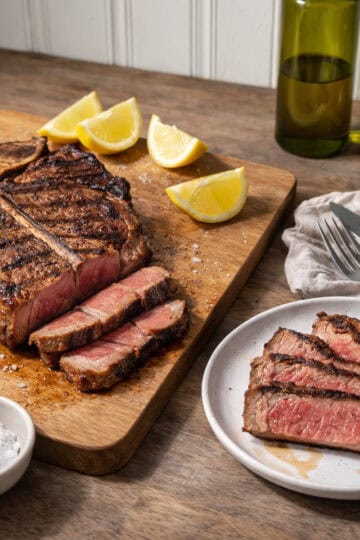
Browning is where flavor begins. High heat and a dry surface trigger the Maillard reaction — the chemical process that transforms pale food into deeply savory, golden, crusted perfection. If your meat releases liquid, sticks to the pan, or stays gray instead of forming a crust, it isn’t browning — it’s steaming. Master the fundamentals of heat, moisture control, and pan contact, and you can consistently brown meat, fish, and vegetables with professional results.
THE RULE
Dry surface.
Hot pan.
Leave it alone.
That’s it. Everything else is detail.
WHAT ACTUALLY HAPPENS
Water must evaporate before browning can begin. If the surface is wet, you’re steaming. Heat must be high enough to exceed roughly 300°F / 150°C. Below that, moisture escapes slowly and the food sweats instead of browning. Protein sticks at first. As a crust forms, it naturally releases from the pan. Move it too soon, and you tear the surface.
Browning is patience under heat.
HOW TO DO IT PROPERLY
- Preheat the pan until it is fully hot — not warm.
- Pat the food dry.
- Season just before cooking.
- Add oil and heat until it shimmers. Add the food and do not move it.
- Flip once, when a crust has formed and the food releases easily.
- Rest after cooking.
That’s the discipline.
GROUND MEAT
- Spread it out in a single layer.
- Let it brown deeply before breaking it apart.
- Stirring too early produces gray meat and weak flavor.
- Deep browning is where most of the final flavor develops.
VEGETABLES
- Space matters. Crowding traps steam and prevents browning.
- Cut pieces to a uniform size for even cooking.
- Use high heat and enough oil to lightly coat the surface.
- Leave them undisturbed long enough to develop color.
- Turn only after browning has formed.
- Salt after browning if excess moisture is a concern.
- High-water vegetables (mushrooms, zucchini, eggplant) require extra space and patience.
THE MYTH
- You do not need meat at room temperature to brown it.
- Cold protein in a properly heated pan will brown.
- Sticking happens because of poor heat control, not internal temperature.
- Trust the crust. It releases when ready.
WHEN BROWNING FAILS
- The pan is not hot enough.
- The surface of the food is wet.
- The pan is overcrowded.
- Heat drops after adding the food.
- The food is moved too soon.
If food is releasing liquid and turning gray, you are steaming, not browning.
WHY BROWNING MATTERS
Browning concentrates flavor, creates texture, and builds the foundation of sauces and finished dishes. Without it, food tastes flat, diluted, and incomplete. Proper browning transforms simple ingredients into complex, satisfying food without adding anything extra.
Good browning is not decoration — it is the difference between cooked food and delicious food.Control the Heat. Build the Flavor.
Browning Technique FAQ
Does meat need to be at room temperature before searing?
Not necessarily.
Surface dryness and proper pan heat matter far more than internal temperature. Letting meat sit out for 15–20 minutes can slightly reduce the chill, but it does not meaningfully change browning behavior.
If your protein sticks, the cause is usually:
• The pan was not hot enough
• The surface was wet
• You moved it too soon
Crust formation — not warming — determines natural release.
Why does my meat stick to the pan?
Protein bonds to metal when first placed in a hot pan. As browning develops, the crust forms and the meat releases naturally.
If it sticks aggressively:
• The pan wasn’t preheated long enough
• The heat is too low
• There isn’t enough fat
• You tried to flip too early
Leave it undisturbed. Release is the signal.
Why is my meat gray instead of brown?
Gray meat indicates steaming, not searing.
This happens when:
• The pan is overcrowded
• The surface was wet
• The heat was insufficient
Moisture must evaporate before browning begins. If water is present, surface temperature stays too low for the Maillard reaction.
Can you brown food in a nonstick pan?
Yes, but you’ll develop less fond and less aggressive crust compared to stainless steel or cast iron.
Nonstick pans limit surface adhesion, which also limits fond formation — the browned bits that build sauces and gravies.
For deep browning and pan sauces, stainless steel or cast iron performs better.
What oil is best for browning?
Use oils with moderate to high smoke points:
• Neutral oils (canola, avocado, grapeseed)
• Clarified butter or ghee
Butter alone browns quickly due to milk solids and can burn if heat is excessive.
Choose fat based on temperature and desired flavor.
Why does browning matter so much?
Browning develops complex savory compounds that seasoning alone cannot replicate.
Salt enhances flavor.
Fat carries flavor.
Heat creates flavor.
Without proper browning, dishes taste flat — even when properly seasoned.
Should I salt before or after browning?
For thicker cuts, salting 30–60 minutes before cooking improves surface dryness and seasoning penetration.
For vegetables, salt after browning begins to prevent early moisture release.
Timing affects moisture — and moisture affects browning.
How do I know when to flip?
Look for:
• Deep golden-brown surface
• Crisp edges
• Natural release from the pan
If it resists, it isn’t ready.
Patience builds crust.
Does browning cook food faster?
No.
Browning develops flavor at the surface. Internal doneness is controlled separately by temperature and time.
Crust and doneness are related — but not the same.
Comments
No Comments