
By Chef Samantha Tilley, executive chef at The Market CT and former chef-owner of Mockingbird Kitchen & Bar.
Cornbread is older than the United States. Native peoples across the Americas ground corn and baked it into flat cakes long before Europeans arrived, and early settlers in the South learned from them, making corn pone and ash cakes baked on hearthstones and in the coals. Wheat flour was expensive in the South and corn grew everywhere, so cornbread became the everyday bread of the region, made by enslaved cooks, sharecroppers and farm families alike, and baked in the cast iron skillet that was in every kitchen. Old-fashioned Southern cornbread was savory, made with buttermilk and no sugar, because it was meant to sit beside beans, greens and pork, not on the dessert plate. The sweet, cake-like cornbread many people know today grew up in the North.
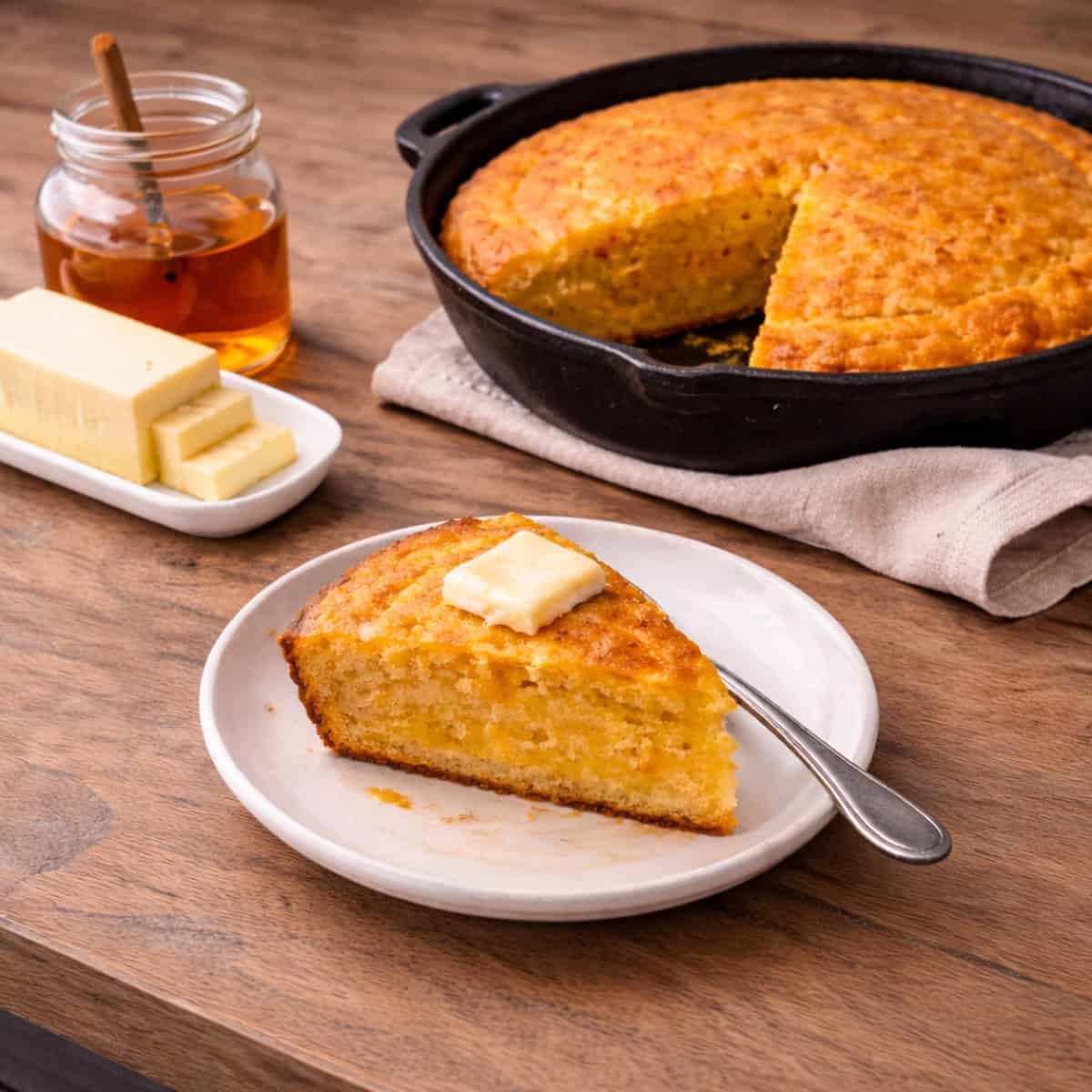
Southern cornbread is a few ingredients and one non-negotiable rule: the skillet has to be screaming hot. When the batter hits hot fat it sizzles, and that sizzle is the crisp, lacy crust you want on the bottom and edges. Everything else is restraint. Let the cornmeal hydrate, stir gently, and pull it from the oven the moment it's set.
Turn it out of the skillet still crackling, cut a wedge while it steams, and drag a pat of butter across the top. It tastes like corn, not cake. Serve it next to a pot of greens with the potlikker for dunking, and nobody will leave a crumb.
Technique Intelligence
Technique: Breads & Doughs · Chapters 38 to 40 · Technique School
Preheat the skillet with the fat in it
Put a 10-inch cast iron skillet in the oven while it heats. Add the butter or bacon fat and let it get hot before the batter goes in. No hot pan, no crust. Use thick oven mitts; that handle will be blazing.
Let the batter rest
Cornmeal absorbs liquid slowly. Let the batter sit 5 to 10 minutes before it goes into the skillet. It bakes up with an even crumb instead of a gritty one.
Buttermilk and baking soda work together
Buttermilk's acid reacts with baking soda to lift and tenderize the bread, and it adds a tang that tastes rich without any sweetness. Don't swap in regular milk; you lose both the rise and the flavor.
Don't overmix
Once the wet and dry ingredients meet, stir only until they're combined. A few lumps are fine. Overmixing develops the gluten in the flour and makes cornbread dense and tough.
Pull it when it's just set
Bake until the top is golden and a toothpick in the center comes out clean. A few extra minutes is the difference between tender and dry.
Ingredient Intelligence
Stone-Ground Cornmeal
A medium grind gives texture without grit, and stone-ground cornmeal keeps more of the corn's germ, so it tastes deeper and sweeter on its own. Because it still has its natural oils, store it in the refrigerator or freezer. Anson Mills and Bob's Red Mill are both good stone-ground choices.
All-Purpose Flour
A little flour lightens the structure so the crumb isn't heavy. Some old Southern recipes use none at all; they're more crumbly and even more corn-forward.
Buttermilk and Eggs
Buttermilk brings tang, tenderness and lift. Eggs hold the bread together so it slices cleanly.
Butter or Bacon Fat
Bacon fat is the old way, and it gives the crispiest, most savory edges. Butter is milder and browns beautifully. I use Kerrygold or Plugrá.
Salt, and No Sugar
Corn needs salt to taste alive. Traditional Southern cornbread has no sugar; the stone-ground cornmeal brings its own sweetness.
Variations
- Crispier and thinner: Bake it in a 12-inch skillet and start checking 5 minutes early.
- Richer crumb: Replace 2 tablespoons of the buttermilk with heavy cream.
- Jalapeño and cheddar: Fold in 1 minced jalapeño and ¾ cup shredded sharp cheddar.
- Cracklin' cornbread: Fold in ½ cup crumbled crispy bacon or pork cracklings.
- For dressing: Bake a skillet a day or two ahead, crumble it and let it dry for Southern cornbread dressing.
- Gluten-free: Replace the flour with a 1:1 gluten-free blend; the texture will be slightly more delicate.
Make Ahead, Storage and Freezing
Make ahead: Cornbread is best warm the day it's baked. Bake it earlier in the day and reheat before serving.
Storage: Wrap well and keep at room temperature up to 2 days.
Freezing: Freeze tightly wrapped slices up to 2 months.
Reheating: Warm slices in a 300°F oven for 8 to 10 minutes to bring back the crust.
What to Serve with Southern Cornbread
- Collard greens with smoked turkey or ham hock, and the potlikker for dunking
- Black-eyed peas or a pot of beans
- Southern Fried Chicken
- Pulled Pork or chili
- For brunch: split, toast and top with a fried egg and hot sauce
- For a party: cut into small wedges, brush with melted butter and sprinkle with flaky salt
Southern Cornbread FAQ
Why is there no sugar in Southern cornbread? Traditional Southern cornbread is a savory everyday bread meant to go with beans, greens and pork. Sweet cornbread is the Northern style.
Why is my cornbread dry? It was overbaked or had too much flour. Measure carefully and pull it as soon as it's set.
Why didn't I get crispy edges? The skillet wasn't hot enough before the batter went in.
Do I need a cast iron skillet? It gives the best crust. A heavy oven-safe skillet or a preheated metal baking pan works, but the edges won't be as crisp.
What's the difference between cornbread and spoon bread? Spoon bread hydrates the cornmeal in hot milk and uses more eggs, so it's soft and custard-like and eaten with a spoon. Skillet cornbread slices.
Can I make it gluten-free? Yes. Replace the flour with a 1:1 gluten-free blend.

Old-Fashioned Southern Cornbread | Cast Iron | No Sugar

Ingredients
Ingredients
- 1 cup yellow cornmeal regular grind, such as Quaker
- 1 cup all-purpose flour
- 1 tablespoon baking powder
- ½ teaspoon baking soda
- 1¼ teaspoons kosher salt
- 2 large eggs
- 1½ cups buttermilk
- 4 tablespoons unsalted butter melted
- 1 tablespoon neutral oil or bacon drippings for skillet
Optional:
- Freshly ground black pepper
- Additional bacon drippings for flavor
Instructions
- Heat the skillet: Preheat the oven to 425°F. Place a 10-inch cast iron skillet in the oven to heat for 8 to 10 minutes.
- Mix the dry ingredients: In a mixing bowl, whisk together 1 cup yellow cornmeal, 1 cup all-purpose flour, 1 tablespoon baking powder, ½ teaspoon baking soda and 1¼ teaspoons kosher salt.
- Mix the wet ingredients: In a separate bowl, whisk 2 large eggs, 1½ cups buttermilk and 4 tablespoons melted unsalted butter until smooth.
- Combine: Pour the wet ingredients into the dry mixture and stir just until combined.
- Rest the batter: Let the batter rest for 3 minutes to hydrate the cornmeal.
- Oil the skillet: Carefully remove the hot skillet. Add 1 tablespoon neutral oil or bacon drippings and swirl to coat the bottom and sides.
- Pour the batter: Immediately pour the batter into the hot skillet. It should sizzle on contact. Smooth the top quickly.
- Bake: Bake at 425°F for 18 to 22 minutes, until deeply golden and the center springs back when lightly pressed.
- Rest and serve: Rest for 10 minutes, then slice into wedges and serve warm.
Notes
Refrigerator: Up to 5 days.
Freeze: Wrap individual wedges and freeze up to 2 months. Reheat Reheat at 350°F for 8–10 minutes for best texture. Skillet reheating with a small pat of butter restores crispness.
Made this? Leave a star rating and a comment below: butter or bacon fat, and what do you serve it with? I read every comment.
Comments
No Comments