
By Chef Samantha Tilley, executive chef at The Market CT and former chef-owner of Mockingbird Kitchen & Bar.
Bistecca alla Fiorentina is the great steak of Florence. A popular story traces its name to the Feast of San Lorenzo, when the Medici family roasted beef over bonfires for the city, and English visitors in the crowd called out for "beef steak," which Florentines turned into bistecca. Whatever the truth, the steak has been the pride of Tuscany for generations. It's traditionally cut from Chianina cattle, a giant, ancient white breed from the Val di Chiana south of Florence, grilled over wood or charcoal, served rare and shared at the table. In Florence's trattorie, it's sold by weight and rarely served cooked past rare.
Bistecca isn't about seasoning, sauces or clever technique. It's about a massive cut of beef, fierce heat and knowing when to stop interfering. The steak is thick, at least 2 inches, and cooked directly over intense heat. Salt goes on just before grilling, olive oil after slicing. The goal is contrast: a deep, dark crust, a warm red center and fat that's rendered but not melted away. If the beef is good and the cook shows restraint, it succeeds. Heat does the work; timing finishes it.
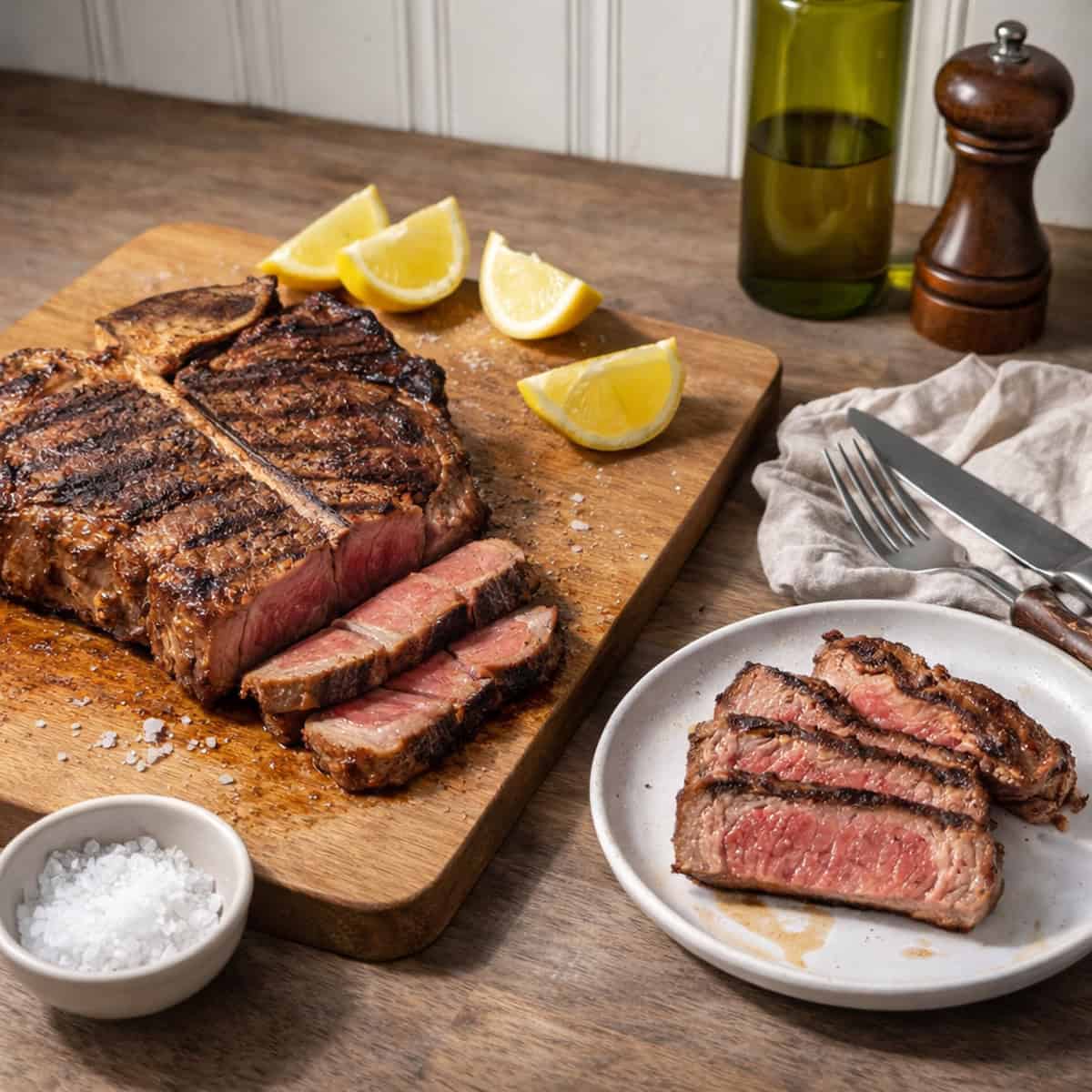
The steak hits the grill with a roar, and the smell of charred beef and smoke drifts across the yard. Stand it on the bone so the fat crackles, rest it, then carve it into thick, rosy slices around the bone. A drizzle of green Tuscan olive oil, a pinch of salt, a glass of Chianti. Nothing else is needed.
Technique Intelligence
Technique: Grill & Open Fire · Chapter 18 · Technique School
Temper the steak
Take the steak out of the refrigerator 1 to 2 hours before cooking. A thick, cold steak chars on the outside before the center warms.
Make the fire very hot
The grill should be hot enough that you hesitate before laying the meat down. Heat a charcoal grill or a heavy cast-iron grill pan for 10 to 15 minutes. Don't oil the grates or the steak; olive oil comes at the end. A gray interior or a weak crust usually means the heat wasn't high enough.
Salt, then leave it alone
Salt the steak generously right before it goes on, pat the surface dry, and let it cook untouched until a deep crust forms, 5 to 6 minutes. Flip once. Constant flipping and moving is how it overcooks.
Stand it on the bone
After both sides are seared, stand the steak upright on its bone for 2 to 3 minutes. The bone shields the meat while the fat along the edge renders and crisps.
Use a thermometer, then rest
In Florence, bistecca is served rare: 120 to 125°F in the thickest part of the strip. For medium-rare, pull it at 130°F. Rest 5 to 10 minutes, then cut the meat away from the bone, slice it against the grain and arrange it back around the bone.
Ingredient Intelligence
The Steak
Use a thick-cut porterhouse or T-bone, at least 2 inches thick and 2 to 2½ pounds, with the bone in. A porterhouse has a larger piece of tenderloin. Chianina beef is rarely available outside Italy; ask your butcher for a dry-aged prime or choice porterhouse cut to order. Thickness matters more than anything else.
Salt
Coarse sea salt or kosher salt, such as Diamond Crystal, applied generously. A thick steak needs more than you think.
Extra-Virgin Olive Oil
A peppery, green Tuscan olive oil drizzled over the sliced steak is the only sauce. Use your best bottle here.
Pepper and Lemon
Black pepper and lemon at the table are optional. They're common outside Tuscany, but not traditional in Florence, where the steak is served without sauce or butter.
Variations
- Cast iron indoors: Sear in a smoking-hot cast-iron grill pan with the fan on, then finish in a 400°F oven if the center needs more time.
- Rosemary: Lay a few rosemary sprigs on the coals for aromatic smoke.
- Tagliata: Slice the steak and serve over arugula with shaved Parmigiano and a drizzle of olive oil.
- Reverse sear: For very thick steaks, roast at 250°F until 110°F inside, then sear hard on the grill.
Make Ahead, Storage and Freezing
Make ahead: Light the fire and temper the steak ahead; grill just before serving.
Storage: Bistecca is best the moment it's sliced. Wrap leftovers and refrigerate up to 3 days.
Freezing: Not recommended for cooked steak.
Reheating: Reheating is a compromise. Cold slices the next day, on good bread with olive oil, are the better option.
What to Serve with Bistecca alla Fiorentina
- Cannellini beans dressed with olive oil and sage, the classic Tuscan side
- Bitter greens, sautéed spinach or roasted potatoes with rosemary
- Focaccia or crusty Tuscan bread
- Tiramisu for dessert
- Chianti Classico, the natural Florentine pairing; Brunello di Montalcino for something more serious; or a traditional Barolo, Barbaresco or Langhe Nebbiolo. Avoid heavily oaked, plush reds.
Bistecca alla Fiorentina FAQ
What cut is bistecca alla fiorentina? A thick porterhouse or T-bone from the loin, with both the strip and the tenderloin on the bone.
How thick should it be? At least 2 inches, often thicker. In Florence, it's typically cut three fingers thick.
How is it cooked in Florence? Rare, over very hot wood or charcoal. Most Florentine restaurants won't cook it past medium-rare.
What temperature should it reach? 120 to 125°F for rare, or 130°F for medium-rare, in the thickest part.
How many people does it serve? A 2- to 2½-pound steak serves 2 generously, or 3 to 4 with sides.
Bistecca alla Fiorentina

Ingredients
Ingredients
Protein
- 1 large T-bone or porterhouse steak 2–2½ lb, at least 2 inches thick
Seasoning & Finish
- 1 tablespoon salt kosher or coarse sea salt
- 2 tablespoon Extra-virgin olive oil for finishing
- ½ teaspoon Freshly cracked black pepper optional, at the table
- 1 lemon cut into wedges, optional
Instructions
- Temper the steak: Take the T-bone or porterhouse steak (2 to 2½ lb) out of the refrigerator 1 to 2 hours before cooking to bring it to room temperature.
- Heat the grill: Heat a grill or cast-iron surface until very hot, about 10 to 15 minutes. Do not oil the grates or the steak.
- Salt: Season the steak on all sides with 1 tablespoon coarse salt immediately before grilling.
- Sear the first side: Place the steak on the grill and cook 5 to 6 minutes without moving it, to form a deep crust.
- Sear the second side: Flip and cook another 5 to 6 minutes, until an instant-read thermometer in the thickest part of the strip side reads 120 to 125°F for rare, the Florentine way, or 130°F for medium-rare.
- Render the fat: Stand the steak upright on the bone and cook 2 to 3 minutes to render the fat.
- Rest: Remove from the heat and rest 5 to 10 minutes.
- Slice: Cut the strip and tenderloin away from the bone, slice each against the grain about ½ inch thick, and arrange the slices back around the bone.
- Finish: Drizzle with 2 tablespoons extra-virgin olive oil and finish with ½ teaspoon cracked black pepper and 1 lemon cut into wedges, if desired.
Notes
Made this? Leave a star rating and a comment below: grill or cast iron? I read every comment.
Comments
No Comments