
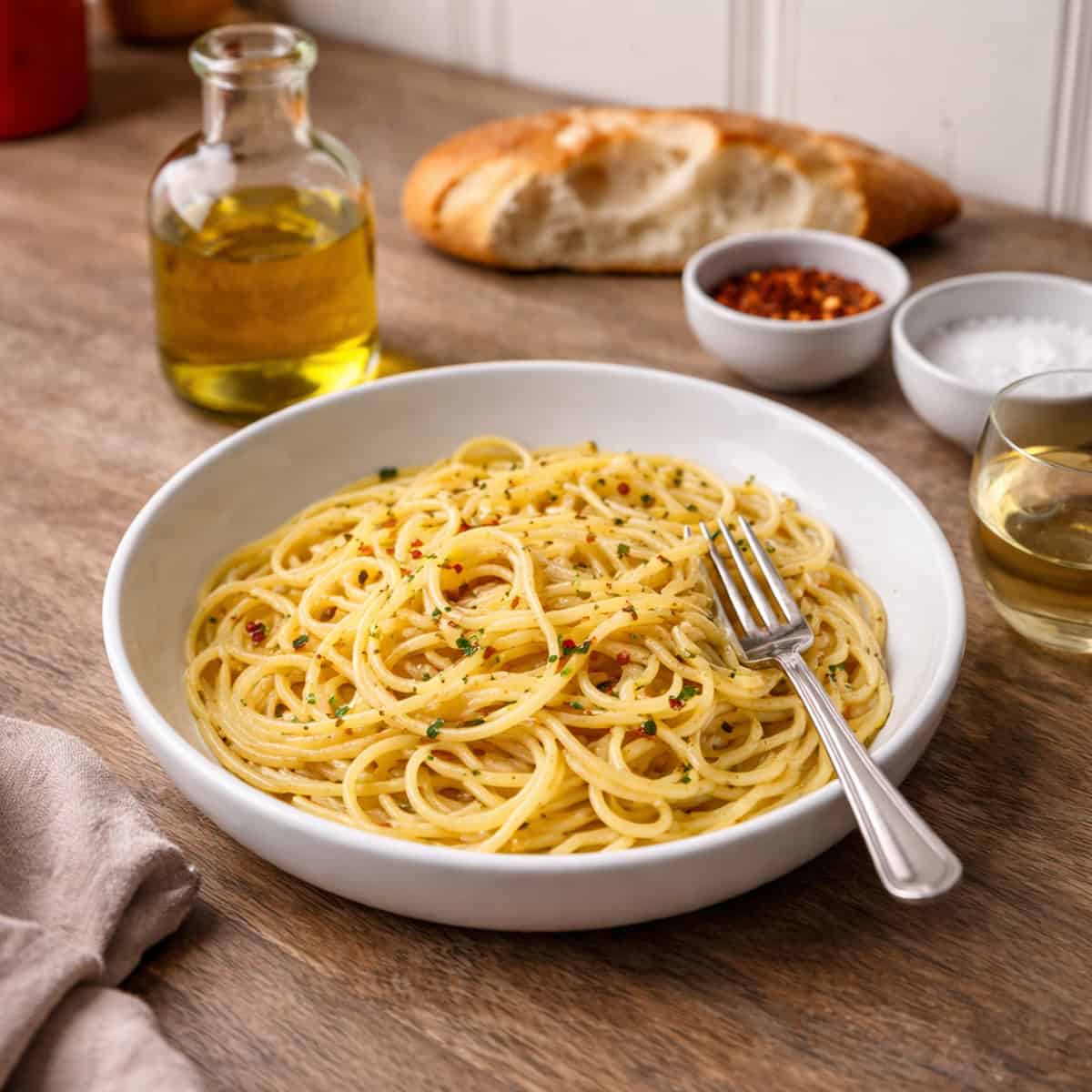
Spaghetti aglio e olio is what you cook when the pantry looks bare but dinner still matters. Olive oil, garlic, dried chili, and pasta — nothing decorative, nothing hidden, nothing to distract from technique. In Italy, this is late-night food, travel-day food, end-of-week food — proof that a few good ingredients, handled properly, are enough.
Flavor develops in real time as garlic gently perfumes the oil and starchy pasta water forms a light emulsion that coats each strand. When done correctly, the result is glossy, clean, and deeply satisfying.
This is not “simple pasta.” It is a foundational dish that shows how Italian cooking works: start with what you have, apply heat, timing, and restraint, and let the ingredients speak.
Why This Dish Matters
Aglio e olio is one of the purest demonstrations of how Italian cuisine builds flavor from fundamentals. Mastering it teaches skills that transfer across countless pasta dishes:
- Gentle aromatic cooking without browning
- Controlling olive oil temperature
- Using pasta water as a structural ingredient
- Creating a stable oil-water emulsion
- Finishing pasta in sauce rather than topping it
If a cook can produce a silky aglio e olio, they are no longer dependent on recipes — they understand a pattern.
Ingredient Intelligence
Extra Virgin Olive Oil
The primary flavor carrier. Choose a fresh oil with peppery finish rather than neutral bulk oil. Heat should be low enough to preserve aroma, not fry aggressively.
Garlic
Thin slicing releases flavor gradually and prevents scorching. Minced garlic burns too quickly and produces harsh bitterness. The goal is gentle softening, not browning.
Dried Chili (Peperoncino)
Provides warmth rather than dominant heat. In Italy this is typically crushed dried chili, not chili powder or sauce.
Dried Pasta (Spaghetti)
Long strands create optimal surface area for the emulsified oil to cling. Bronze-cut pasta improves sauce adhesion due to its rough texture.
Parsley (Optional)
Adds freshness and visual contrast. Some Roman cooks omit it entirely for a purer profile.
Salted Pasta Water
Not merely cooking liquid — this is the structural component that turns oil into sauce. Its starch content allows emulsification.
Technique Intelligence
Infusion, Not Frying
Garlic should perfume the oil gently. If it turns dark golden or brown, bitterness will dominate the dish.
Heat Management
Start low to protect the garlic, then increase briefly during emulsification.
Emulsification
Agitation combines oil and starchy water into a cohesive sauce. Without sufficient tossing or liquid, the pasta will taste oily rather than silky.
Finish in the Pan
Pasta absorbs sauce as it completes cooking. Draining fully before saucing prevents integration.
Common Failure Points
- Garlic browning too quickly
- Insufficient pasta water
- Oil separating instead of emulsifying
- Pasta overcooking before finishing in sauce
- Waiting too long to serve
This dish deteriorates rapidly once off heat.
Authentic Context
Aglio e olio belongs to the Roman tradition of cucina povera — cooking that transforms humble ingredients into satisfying meals. It is often prepared late at night, after travel, or whenever the pantry is sparse but olive oil and pasta remain.
Its simplicity is deceptive; Italian cooks judge technique heavily on dishes like this.
Variations & Next Steps
Once mastered, this base supports several authentic extensions:
- Addition of olives for briny depth (your linked variation)
- Anchovies for umami richness
- Toasted breadcrumbs in Southern Italian styles
- Lemon zest for brightness
Each variation builds on the same technique rather than replacing it.
Serving Notes
Serve immediately in warmed bowls. Pair with a simple salad or grilled vegetables. In Italy this is typically a first course, but it functions perfectly as a main dish at home.
The Real Lesson
Aglio e olio demonstrates that Italian cooking is not ingredient-driven but method-driven. When technique is correct, a handful of pantry staples becomes deeply nourishing and complete.
Or more plainly: this is proof that dinner does not require complexity — only attention.
Spaghetti Aglio e Olio (Authentic Roman Garlic & Olive Oil Pasta)

Equipment
- Large pasta pot
- Wide skillet or sauté pan
- Tongs
- Ladle or heatproof cup
- Colander (optional)
Ingredients
Ingredients
- 8 oz 225 g spaghetti
- ¼ cup 60 ml extra virgin olive oil
- 4 –5 cloves garlic thinly sliced
- ½ teaspoon crushed red pepper flakes or to taste
- ¼ cup fresh parsley finely chopped (optional)
- Kosher salt for pasta water
- ½ –1 cup reserved pasta cooking water as needed
- Optional — Italian-American Variation:
- 1 –2 teaspoon fresh lemon juice to taste
- Freshly grated Parmigiano-Reggiano
Instructions
Instructions
- Bring a large pot of water to a rolling boil and salt it generously until it tastes like the sea. Add 8 oz (225 g) spaghetti and cook for about 8–10 minutes, stirring occasionally to prevent sticking.
- Begin testing early for al dente. Lift a strand with tongs and bite through it. The pasta should be tender on the outside with a faint firm core in the center — not crunchy and not fully soft. A tiny opaque line or dot in the middle indicates it is ready to finish in the sauce.
- While the pasta cooks, pour ¼ cup (60 ml) extra virgin olive oil into a wide skillet and warm over medium-low heat. Add 4–5 thinly sliced garlic cloves and cook gently, stirring often, until softened and fragrant. The goal is to perfume the oil, not brown the garlic.
- Add ½ teaspoon crushed red pepper flakes and cook briefly to infuse the oil.
- Before draining, reserve about 1 cup of the starchy pasta cooking water. Using tongs, transfer the nearly cooked pasta directly into the skillet. Add about ¼ cup pasta water to start.
- Increase heat to medium and toss continuously. The oil and starchy water will combine into a silky emulsion that coats the pasta. Add additional pasta water, a few tablespoons at a time, until the pasta looks glossy and fluid rather than oily or dry.
- Continue tossing until the pasta is tender and fully cooked. The sound in the pan will shift from watery bubbling to a softer sizzling as the sauce tightens around the noodles.
- Remove from heat. Stir in ¼ cup chopped fresh parsley if using. For the Italian-American variation, add 1–2 teaspoons fresh lemon juice and toss gently to brighten the dish. Taste and adjust salt.
- Serve immediately while glossy and aromatic. Optional grated Parmigiano-Reggiano may be added at the table.

Comments
No Comments