
(Pizza in Teglia Romana)
Roman pizza doesn’t chase attention. It earns it.
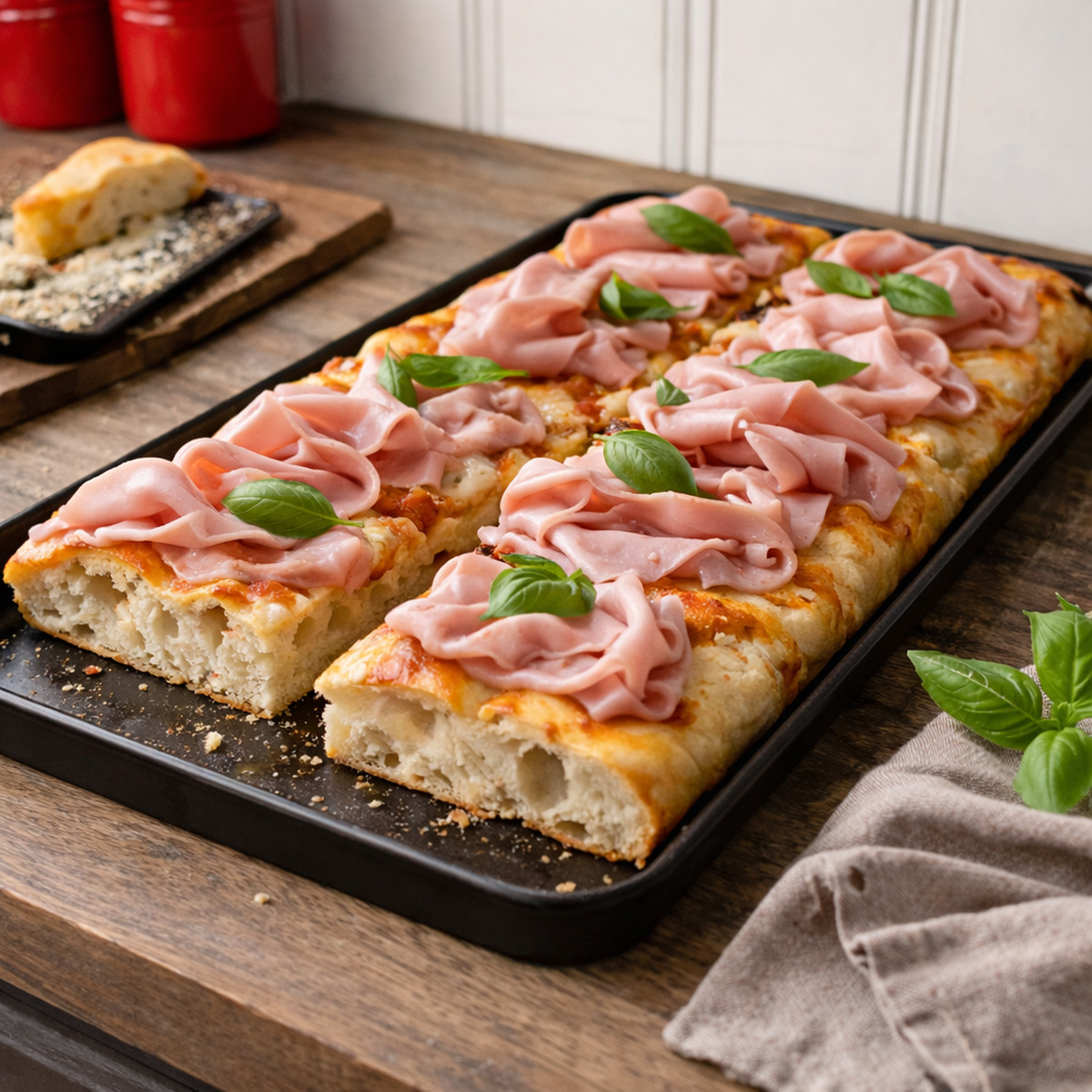
This is pizza built on dough — how it’s mixed, how it rests, how it’s handled, and how it bakes. Long fermentation, high hydration, olive oil, and a rectangular pan that lets heat work evenly and aggressively across the crust.
It’s meant to be cut into squares, eaten standing up, and judged by texture more than toppings. Crisp underneath. Open and airy inside. Light enough that you reach for another piece before you realize you’re still hungry.
If Neapolitan pizza is theater, Roman pizza is engineering.
What Makes Roman Pizza Different
Roman pizza baked in a long pan is defined by contrast.
The bottom is deeply crisp, almost fried in olive oil.
The interior is light and honeycombed.
The crust holds its shape without feeling heavy.
This comes from three things working together:
- High hydration dough
- Long fermentation
- Even heat across a shallow metal pan
This isn’t a dough you stretch theatrically. It’s a dough you move carefully, preserving the air it worked so long to create.
Ingredient Intelligence
Flour
Roman pizza depends on strength, not softness.
You want a flour with enough protein to support high hydration and extended fermentation without collapsing. Weak flour tears and spreads. Strong flour stretches, traps gas, and bakes into an open crumb.
Italian 00 pizza flour or a strong bread flour both work, as long as the dough remains elastic and resilient over time.
Water
Water is the largest ingredient in the dough, and it shows.
Clean, neutral-tasting water allows fermentation to develop naturally. Water that’s overly chlorinated or mineral-heavy can mute flavor and slow yeast activity.
High hydration is intentional here. Sticky dough isn’t a mistake — it’s the point.
Yeast
Roman pizza relies on time, not yeast.
Only a small amount is needed when the dough is allowed to ferment slowly. Too much yeast produces fast rise, weak structure, and flat flavor.
The dough should feel alive, not inflated.
Olive Oil
Olive oil plays two roles.
In the dough, it tenderizes the crumb.
In the pan, it’s responsible for the golden, crisp underside that defines pizza in teglia.
This isn’t background flavor. You taste the oil in the finished crust, so it needs to be clean and fresh.
Salt
Salt does more than season.
It strengthens gluten, controls fermentation, and ensures the dough tastes complete even before toppings are added. Under-salted dough ferments poorly and bakes bland.
Tomatoes (If Using)
Roman pizza is dough-forward.
Tomatoes are used sparingly, often crushed by hand and applied lightly. The goal is balance — not a wet surface that steams the crust.
Cooked sauces are rarely necessary.
Why This Method Works
This method works because it lets the dough finish itself.
- Long fermentation builds flavor without additives
- High hydration creates an open crumb
- Minimal handling preserves gas
- A long pan ensures even thickness and consistent heat
Nothing is rushed. Nothing is forced.
The baker’s job is mostly restraint.
Where Equipment Matters
A Roman-style long pan isn’t just a shape choice — it defines the bake.
The shallow metal pan conducts heat evenly across the dough, allowing moisture to escape while olive oil crisps the bottom. Corners brown at the same rate as the center. Thickness stays consistent edge to edge.
A digital scale matters too. Roman dough ratios don’t forgive guessing. Precision here prevents problems later.
Equipment
- Roman-style long pan (pizza in teglia pan)
- Digital scale
- Large mixing bowl
- Bench scraper
- Oiled proofing container
- Oven with strong bottom heat
Optional but useful:
- Dough tub (for high-hydration handling)
- Infrared thermometer
How Roman Pizza Is Topped
Toppings are applied deliberately.
Some go on before the bake. Others after. Moisture is controlled carefully so the crust stays crisp.
Classic combinations are simple:
- Tomato and olive oil
- Potato and rosemary
- Mortadella added after baking
- Burrata torn over hot crust
This is pizza built for balance, not overload.
How It’s Served
Roman pizza is cut into rectangles or squares and eaten warm or at room temperature. It holds well, reheats beautifully, and doesn’t collapse under its own weight.
Good Roman pizza feels light even when it’s satisfying.
Wine Pairing
Roman pizza is crisp, restrained, and built on balance rather than excess. The wine should follow suit.
The natural pairing is Frascati—Rome’s historic white. Light-bodied, dry, and quietly mineral, it refreshes between bites without competing with the dough, tomato, or olive oil. It’s a table wine in the truest sense: meant to be poured, not analyzed.
If you want a little more edge, Bellone or Malvasia Puntinata from Lazio bring subtle aromatics and enough acidity to handle tomato-forward toppings.
For red wine drinkers, keep it light and chilled: Cesanese or a simple Chianti works when the pizza leans savory rather than cheesy. Avoid heavy reds and anything oaked—Roman pizza is about crispness, not weight.
Beer may be common, but wine belongs here too—quietly, confidently, and by the glass.
Roman Pizza in a Long Pan (Pizza in Teglia Romana)

Equipment
- Equipment
- Large mixing bowl
Ingredients
Ingredients
Dough
- 500 g bread flour or Italian 00 pizza flour
- 400 g water 80% hydration
- 10 g fine sea salt
- 2 g instant yeast
- 20 g extra virgin olive oil plus more for the pan
Topping (Basic)
- Crushed tomatoes lightly seasoned (optional)
- Extra virgin olive oil
- Flaky salt
Instructions
Instructions
- Mix the Dough
- In a large bowl, combine 500 g flour and 2 g instant yeast.
- Add 400 g water and mix by hand until no dry flour remains. The dough will be very sticky.
- Cover and rest for 20–30 minutes (autolyse).
Add Salt and Oil
- Sprinkle 10 g salt over the dough and drizzle in 20 g olive oil.
- Using wet hands, fold and squeeze the dough until fully incorporated.
- Cover and let rest for 20 minutes.
Strengthen the Dough
- Perform a series of stretch-and-folds directly in the bowl, folding the dough over itself 3–4 times.
- Rest 20 minutes, then repeat once more.
- The dough should feel elastic and smoother, though still loose.
Bulk Fermentation
- Transfer dough to a lightly oiled container.
- Cover and refrigerate for 18–24 hours.
Pan and Proof
- Remove dough from the refrigerator 2–3 hours before baking.
- Generously oil a Roman-style long pan with olive oil.
- Gently tip the dough into the pan and drizzle lightly with oil.
- Using oiled fingertips, press the dough outward without forcing it.
- Let rest 20 minutes, then gently stretch again until it fills the pan.
- Proof at room temperature until puffy and aerated, 45–75 minutes.
Bake
- Preheat oven to 475°F (245°C) with a rack in the lower third.
- If using tomato, spoon lightly over the dough, leaving bare spots.
- Drizzle with olive oil and sprinkle lightly with salt.
- Bake for 15–20 minutes, rotating once, until the bottom is crisp and the top is lightly golden.
- Remove from the oven and finish with olive oil or post-bake toppings as desired.
Comments
No Comments