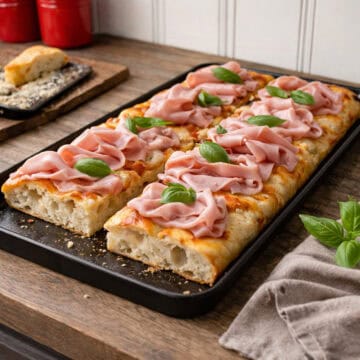
Roman Pizza in a Long Pan (Pizza in Teglia Romana)

A traditional Roman pizza dough fermented slowly, gently handled, and baked in a long pan for a light interior and crisp, golden crust.
Equipment
- Equipment
- Large mixing bowl
Ingredients
Ingredients
Dough
- 500 g bread flour or Italian 00 pizza flour
- 400 g water 80% hydration
- 10 g fine sea salt
- 2 g instant yeast
- 20 g extra virgin olive oil plus more for the pan
Topping (Basic)
- Crushed tomatoes lightly seasoned (optional)
- Extra virgin olive oil
- Flaky salt
Instructions
Instructions
- Mix the Dough
- In a large bowl, combine 500 g flour and 2 g instant yeast.
- Add 400 g water and mix by hand until no dry flour remains. The dough will be very sticky.
- Cover and rest for 20–30 minutes (autolyse).
Add Salt and Oil
- Sprinkle 10 g salt over the dough and drizzle in 20 g olive oil.
- Using wet hands, fold and squeeze the dough until fully incorporated.
- Cover and let rest for 20 minutes.
Strengthen the Dough
- Perform a series of stretch-and-folds directly in the bowl, folding the dough over itself 3–4 times.
- Rest 20 minutes, then repeat once more.
- The dough should feel elastic and smoother, though still loose.
Bulk Fermentation
- Transfer dough to a lightly oiled container.
- Cover and refrigerate for 18–24 hours.
Pan and Proof
- Remove dough from the refrigerator 2–3 hours before baking.
- Generously oil a Roman-style long pan with olive oil.
- Gently tip the dough into the pan and drizzle lightly with oil.
- Using oiled fingertips, press the dough outward without forcing it.
- Let rest 20 minutes, then gently stretch again until it fills the pan.
- Proof at room temperature until puffy and aerated, 45–75 minutes.
Bake
- Preheat oven to 475°F (245°C) with a rack in the lower third.
- If using tomato, spoon lightly over the dough, leaving bare spots.
- Drizzle with olive oil and sprinkle lightly with salt.
- Bake for 15–20 minutes, rotating once, until the bottom is crisp and the top is lightly golden.
- Remove from the oven and finish with olive oil or post-bake toppings as desired.
Notes
Chef Notes
High hydration is intentional — resist adding flour.
Gentle handling preserves the open crumb.
Olive oil in the pan is essential for proper browning.
Roman pizza should be crisp underneath, not soft or bready.
Storage
Best eaten the day it’s made.
Leftovers can be reheated directly on the oven rack or in a hot pan to restore crispness.
Tried this recipe?Let us know how it was!
