
Ribollita is not a soup you “invent.” It’s a soup you inherit.
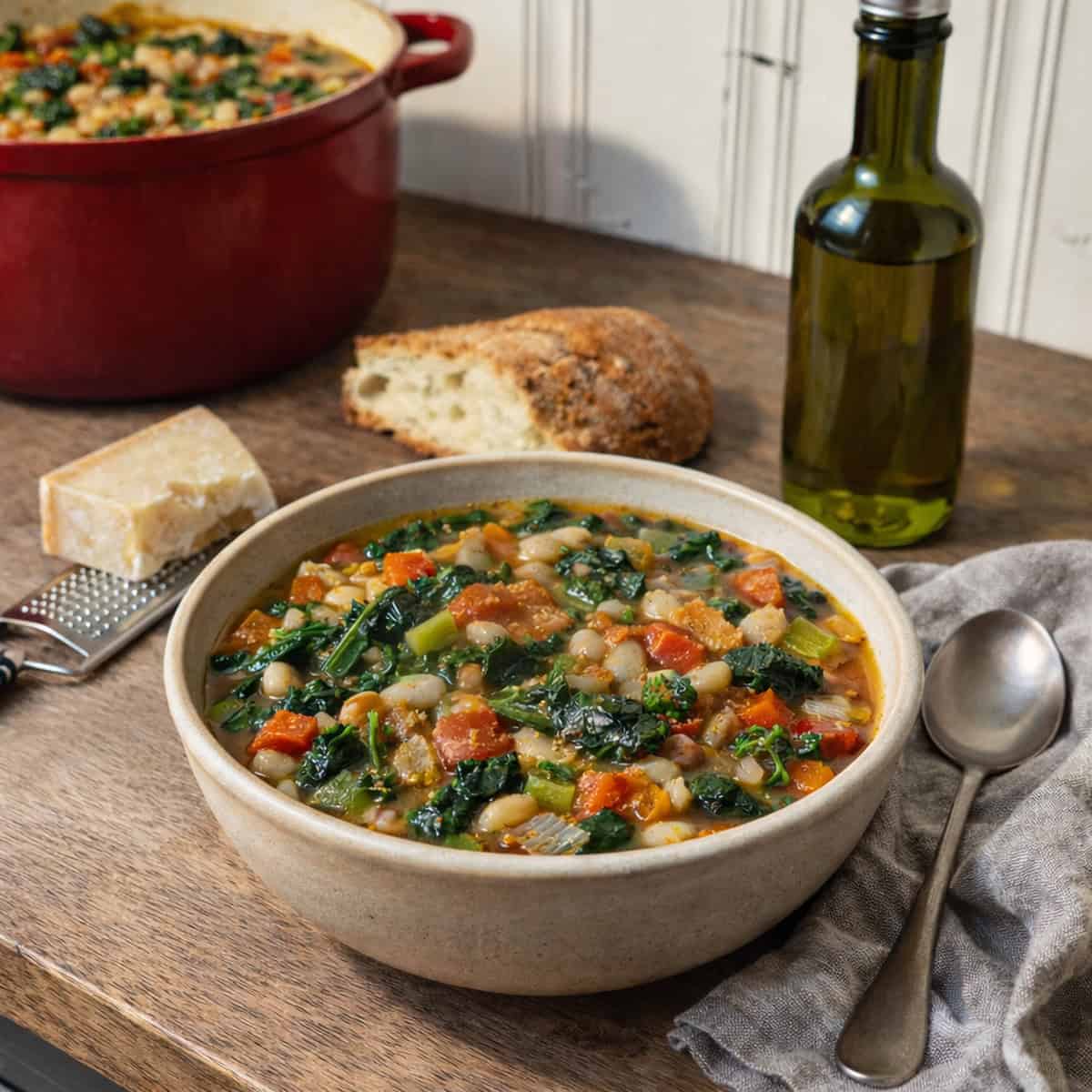
Born out of necessity in Tuscany, ribollita is what happens when yesterday’s bread, yesterday’s beans, and whatever vegetables are still standing come together and refuse to be wasted. It’s peasant food in the truest sense — not rustic as an aesthetic, but practical, thrifty, and deeply satisfying.
The name literally means reboiled. That’s not branding. That’s instruction.
And the reason ribollita endures isn’t nostalgia. It’s because it works.
What Ribollita Is (and Isn’t)
Ribollita is not minestrone.
It is not a thin vegetable soup.
And it is absolutely not meant to be brothy.
This is a thick, spoon-standing dish built on:
- Cannellini beans
- Dark leafy greens (traditionally cavolo nero)
- Aromatic vegetables
- Stale Tuscan bread
The bread dissolves into the soup, giving it body and richness without cream or starch. The beans provide protein and depth. Olive oil finishes the job.
When it’s right, ribollita eats like a meal, not a starter.
Ingredient Intelligence
Beans
Cannellini beans are the backbone.
They bring creaminess without heaviness and absorb flavor without losing their shape. Traditionally, some of the beans are mashed or blended into the soup, thickening it naturally.
Canned beans work. Dried beans are better. What matters most is that the beans taste good on their own.
Cavolo Nero (Tuscan Kale)
This is the soul of ribollita.
Cavolo nero is darker, sturdier, and more mineral than standard kale. It holds its structure through long cooking and brings a subtle bitterness that balances the beans and bread.
If you can’t find it, lacinato kale is the closest substitute. Curly kale changes the texture and flavor — use it only if you must.
Bread
This is not the place for fresh bread.
Ribollita depends on stale, unsalted Tuscan-style bread. The bread should be dry enough to dissolve slowly, thickening the soup without turning it gummy.
Good ribollita tastes like bread and soup became the same thing.
Aromatics
Onion, carrot, celery, and garlic form the base.
Nothing fancy, nothing optional. These aren’t background flavors — they’re structural. Take the time to sweat them properly so the soup starts sweet and savory before anything else is added.
Olive Oil
Olive oil is not garnish here. It’s a finishing ingredient.
A generous drizzle of good Tuscan olive oil at the end transforms ribollita from filling to memorable. This is where the dish shows its roots.
Technique Intelligence (Why Ribollita Works)
Ribollita is built in stages.
First, you build flavor slowly with aromatics and vegetables. Then beans go in — some whole, some broken down. Bread is added last, allowed to soften and dissolve into the soup.
Then you stop.
The soup rests. It cools. It tightens.
And the next day, you reheat it — gently — with a splash of water or broth and another drizzle of olive oil. That second heating is not a shortcut. It’s the point.
Ribollita is better the day after it’s made. That’s not romance. It’s chemistry.
Why Ribollita Is Reboiled
Letting the soup sit allows:
- Starch from the bread to fully hydrate
- Beans to meld with vegetables
- Bitterness from the greens to soften
- Flavors to round out
The second cooking brings everything back together. The soup becomes thicker, deeper, and more cohesive.
If you only cook ribollita once, you’re missing what makes it ribollita.
Texture Is the Test
Proper ribollita should be:
- Thick, but not dry
- Spoonable, not sliceable
- Rustic, but cohesive
If it pours like broth, it’s wrong.
If it stands like polenta, it’s gone too far.
Wine Pairing
Ribollita comes from a part of Tuscany where wine was everyday fuel, not ceremony. The right pairing respects the soup’s weight without overpowering its simplicity.
A young Chianti or Chianti Colli Senesi works naturally here—bright acidity, modest tannin, and enough earth to echo the beans and greens without stealing focus.
If you prefer white, look to something equally grounded: a Trebbiano Toscano or a dry Verdicchio. High acid matters more than aromatics. The wine should refresh the palate, not announce itself.
Avoid heavy reds or oaked whites. Ribollita isn’t looking for drama—it’s looking for balance.
Equipment You’ll Need
- Heavy-bottomed pot or Dutch oven
- Wooden spoon
- Chef’s knife
- Cutting board
- Ladle
Nothing special. Ribollita was never meant to require anything more.
How Ribollita Is Served
Ribollita is served hot, finished with:
- Extra virgin olive oil
- Freshly cracked black pepper
That’s it.
No cheese. No herbs. No garnish for garnish’s sake. The restraint is the elegance.
Storage
Ribollita keeps exceptionally well.
Refrigerate for up to 4 days. Reheat gently, adding a splash of water or broth as needed. Finish with olive oil every time.
It freezes, but it doesn’t need to. It rarely lasts that long.
Ribollita (Tuscan Bread & Vegetable Soup)

Equipment
- Equipment
Ingredients
Ingredients
- 1 cup dried cannellini beans cooked (or 2 × 15-oz cans, drained)
- 3 tablespoon extra-virgin olive oil
- 1 medium yellow onion diced
- 1 carrot diced
- 1 celery stalk diced
- 2 garlic cloves minced
- 1 bunch Tuscan kale cavolo nero, chopped
Liquids & Structure
- 4 cups vegetable stock or reserved bean cooking liquid
- 3 –4 cups stale Tuscan-style bread torn
- 1 Parmigiano-Reggiano rind optional
- Freshly ground black pepper to taste
Instructions
Instructions
- Heat 3 tablespoons extra-virgin olive oil in a Dutch oven over medium heat.
- Add 1 diced onion, 1 diced carrot, and 1 diced celery stalk; cook 8–10 minutes until soft and translucent.
- Add 2 minced garlic cloves and cook 30 seconds until fragrant.
- Stir in 1 cup cooked cannellini beans, 1 chopped bunch Tuscan kale, 4 cups vegetable stock, and 1 Parmigiano-Reggiano rind (optional). Bring to a gentle simmer.
- Layer 3–4 cups torn stale bread into the pot, pressing lightly into the liquid without stirring aggressively.
- Simmer uncovered 30–40 minutes over low heat until thick and cohesive.
- Remove from heat and allow to cool completely. Reheat gently before serving and finish with black pepper and olive oil as needed.
Notes
Storage & Make-Ahead
- Refrigerator: Store cooled ribollita in an airtight container for up to 4–5 days. Flavor and texture improve after the first day.
- Freezer: Freeze for up to 3 months without cheese. Thaw overnight in the refrigerator.
- Reheating: Reheat gently over low heat, adding a small splash of water or stock only if needed. Avoid boiling.
Comments
No Comments