
A Savory Irish Soda Bread for St. Patrick’s Day
Irish soda bread is not yeast bread. It is not kneaded. It does not wait. It relies on baking soda and buttermilk for lift, and it rewards restraint. This savory version folds sharp Irish cheddar and fresh spring onions into a tender crumb that pairs perfectly with corned beef, soups, or a simple spread of butter.
No rise time. No mixer. Just clean technique and a hot oven.
The Technique: Chemical Leavening Under Control
Baking soda needs acid. Buttermilk provides it. Once combined, carbon dioxide begins forming immediately. That gas is what creates lift. You don’t wait. You don’t “let it rest.” You get it into a fully preheated oven.
Which means:
- Oven at 400°F before mixing begins.
- Baking sheet ready.
- Ingredients measured.
Soda bread rewards readiness. Mix just until the dough comes together. Not smooth. Not elastic. Just cohesive. Overmixing develops gluten and tightens the crumb. You’ll taste it.
Why Cheddar & Spring Onion Work
Sharp Irish cheddar melts into the crumb without turning greasy. It adds depth and salt without overpowering. Spring onions bring freshness. Not heat. Not spice. Just lift. Together they transform a simple soda bread into something that belongs on a holiday table — especially beside corned beef and cabbage.
What You Should Be Watching For
When shaping the loaf: You are forming, not kneading. The dough should feel soft but not sticky. If you’re pushing it aggressively, you’re developing gluten and tightening the crumb.
When scoring: Cut deep — at least ½ inch. That cross isn’t decoration. It allows heat to penetrate the center and supports proper expansion. Shallow scoring leads to cracked sides and uneven baking.
When baking: You want deep golden color. Not pale. Not timid.
Tap the bottom. It should sound hollow. If you’re unsure, check for an internal temperature around 200°F.
Underbaked soda bread feels damp and heavy in the center. That’s not rustic. That’s unfinished.
The Texture Done Right
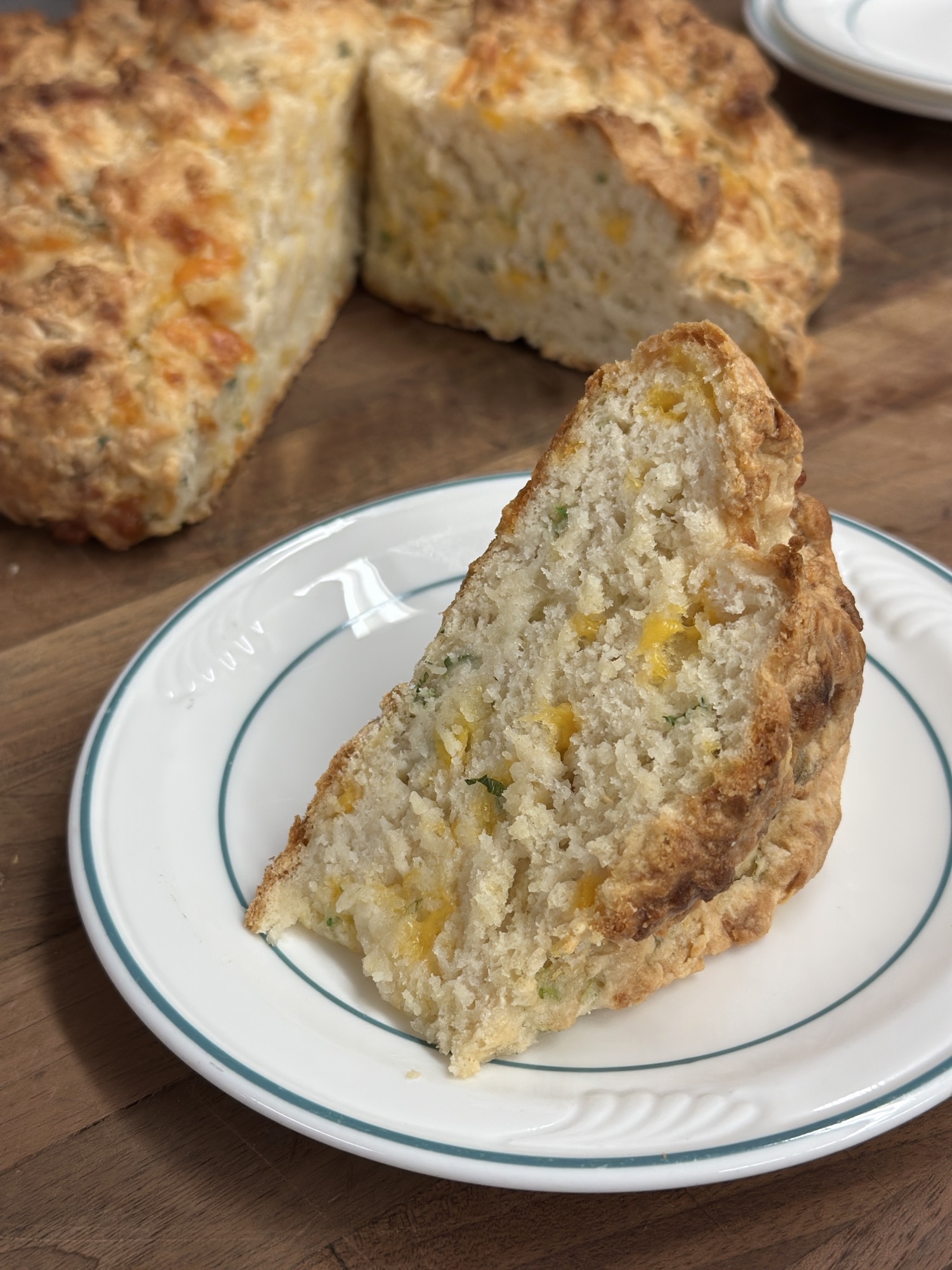
A proper slice should show:
- Tender crumb
- Visible cheddar pockets
- Even distribution of spring onion
- Clean structure without crumbling
It should hold butter without collapsing. It should absorb broth without turning pasty.
Chef Notes
- Whisk baking soda thoroughly into flour to prevent bitter pockets.
- Toss cheese and onions in flour before adding liquid to prevent sinking.
- Score deeply — the cross allows heat to penetrate the center.
- Let the loaf rest at least 20 minutes before slicing.
- You mix quickly. You shape gently. You bake immediately.
These small details determine the crumb.
F.A.Q.
Why is my soda bread dense?
Usually one of three reasons:
- The dough was overmixed.
- The oven wasn’t fully preheated.
- The loaf was underbaked.
Soda bread does not need kneading. Mix just until combined and get it into a hot oven immediately.
Do I need buttermilk?
Yes — or an equivalent acid.
Baking soda requires acid to create lift. If you don’t have buttermilk, mix 1 tablespoon lemon juice or white vinegar into 1½ cups milk and let it sit 5–10 minutes before using.
The acid is not optional. It’s structural. Here are substitue options
Milk + Acid (Best Direct Substitute)
For 1½ cups buttermilk, use:
- 1½ cups whole milk
- 1½ tablespoons lemon juice or white vinegar
Stir and let sit 5–10 minutes. It will thicken slightly.
This is the closest functional match for soda bread.
Plain Yogurt (Very Good)
Use:
- 1 cup plain full-fat yogurt
- ½ cup milk
Whisk until smooth and pourable.
Yogurt gives great tenderness and subtle richness. Excellent in savory soda bread.
Sour Cream (Richer Option)
Use:
- 1 cup sour cream
- ½ cup milk
Whisk until smooth.
This produces a slightly tighter crumb but very tender texture.
Kefir (If You Have It)
Use equal measurement, 1:1.
Kefir works beautifully — similar acidity and thickness.
What Not To Do
- Don’t use plain milk alone.
- Don’t reduce liquid to compensate for thickness.
- Don’t skip the acid entirely.
Soda bread is chemistry. Respect it.
Can I use pre-shredded cheese?
You can, but freshly grated cheddar melts more cleanly and distributes better through the crumb. Pre-shredded cheese contains anti-caking agents that can slightly affect texture.
For best structure, grate it yourself.
Why do you score the top?
The deep cross is not decorative.
It allows heat to penetrate the center and supports expansion. Without scoring, the loaf can crack unevenly along the sides.
Cut at least ½ inch deep.
Can I make soda bread ahead?
Soda bread is best the day it’s baked.
It can be made earlier in the day and kept at room temperature. For serving later, warm slices in a 300°F oven for 5–7 minutes to refresh.
It does not improve overnight the way yeast bread does.
Why is my soda bread gummy inside?
It was either sliced too early or underbaked.
Let the loaf cool at least 20 minutes before slicing. Internal temperature should reach about 200°F when done.
Can I freeze Irish soda bread?
Yes.
Wrap tightly once fully cooled and freeze up to 2 months. Thaw at room temperature and refresh in a low oven before serving.
Can I make this without cheese?
Yes.
Omit the cheddar and spring onions for a more traditional savory soda bread. The technique remains the same.
Storage
- Wrap loosely and store at room temperature up to 2 days.
- To refresh, warm slices in a 300°F oven for 5–7 minutes.
- Soda bread is best the day it’s baked.

Irish Cheddar & Spring Onion Soda Bread

Equipment
- Large mixing bowl
- Whisk
- Wooden spoon or dough scraper
- Box grater (for cheddar)
- Sharp knife (for scoring)
- Baking sheet
- Cooling rack
- Optional: Instant-read thermometer
Ingredients
Ingredients
- 3½ cups 420g all-purpose flour, plus extra for dusting
- 1 teaspoon baking soda
- 1 teaspoon fine salt
- ½ teaspoon freshly ground black pepper
- 1 cup 120g sharp Irish cheddar, grated
- 3 –4 spring onions scallions, thinly sliced
- 1½ cups 360ml cold buttermilk
- 1 tablespoon butter melted (for brushing)
Instructions
Preheat:
- Preheat oven to 400°F (200°C). Line a baking sheet with parchment paper.
Mix Dry Ingredients:
- In a large bowl, whisk together 3½ cups (420g) flour, 1 teaspoon baking soda, 1 teaspoon salt, and ½ teaspoon black pepper until evenly distributed.
Add Cheese & Spring Onions:
- Stir in 1 cup (120g) grated sharp Irish cheddar and 3–4 thinly sliced spring onions, coating them in the flour mixture.
Add Buttermilk:
- Make a well and pour in 1½ cups (360ml) cold buttermilk. Stir gently just until the dough comes together. Do not overmix.
Shape:
- Turn dough onto a lightly floured surface and gently form into a round loaf about 7–8 inches wide. Do not knead. Transfer to baking sheet.
Score:
- Using a sharp knife, cut a deep “X” about ½-inch into the top.
Bake:
- Bake 30–35 minutes, until deep golden brown and hollow when tapped on the bottom. Internal temperature should reach about 200°F.
Finish:
- Brush with 1 tablespoon melted butter. Cool at least 20 minutes before slicing.

Comments
No Comments