
Bread Flour, Whole Wheat Flour, Water, and Timing
A sourdough starter is not a recipe.
It is a living culture.
Flour and water become an ecosystem — wild yeast and lactic acid bacteria establishing balance. Your job is not to force bubbles. Your job is to control environment.
Fermentation rewards discipline.
What a Sourdough Starter Actually Is
A sourdough starter contains:
Wild yeast — responsible for rise
Lactic acid bacteria — responsible for acidity and strength
The yeast lifts the dough.
The bacteria condition it.
Together they ferment more slowly and more deeply than commercial yeast.
This is structure, not speed.
Why Use a Blend of Bread and Whole Wheat Flour?
You can build a starter with white flour alone. But a blend establishes strength faster.
Whole wheat contains bran and germ — which carry:
- More natural yeast
- More lactic acid bacteria
- More minerals
- More enzymes
White flour is mostly starch.
Whole wheat brings infrastructure.
Whole wheat jump-starts microbial activity. Bread flour stabilizes structure.
A reliable starting blend:
50% bread flour
50% whole wheat flour
Once mature, you may transition to mostly bread flour if desired. The culture adapts.
Whole wheat is not required. It makes the early days more resilient.
What You Need
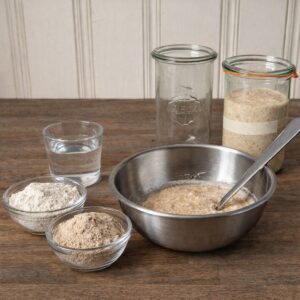
Bread flour
Whole wheat flour
Room-temperature water
Digital scale
Clean jar
Nothing more.
Day 1: Begin
Mix:
50g bread flour
50g whole wheat flour
100g water
Stir until smooth. Cover loosely.
Leave at 70–75°F for 24 hours.
You may see nothing. That is normal.
Day 2: First Feeding
Discard half.
Add:
50g bread flour
50g whole wheat flour
100g water
Stir. Rest 24 hours.
Discarding prevents runaway acidity and maintains balance.
Days 3–5: Establishing Strength
Repeat daily:
Discard half.
Feed 50g bread flour.
Feed 50g whole wheat flour.
Add 100g water.
You may see a dramatic rise around Day 3, followed by collapse. This is early bacterial bloom. Continue feeding consistently.
By Day 5–7, you want:
Regular bubbling
Pleasant tangy aroma
Clear rise and fall pattern
If cool, allow up to 10 days.
Temperature is the throttle.
When Is a Sourdough Starter Ready?
A mature starter should:
Double in volume within 4–6 hours after feeding
Have a slightly domed surface at peak
Smell clean and mildly sour
Feel airy and elastic
Mark the jar after feeding. Watch it rise.
When it reliably doubles and gently falls, it is strong enough to leaven bread.
Strength equals predictability.
When Do You Use the Starter? (Peak Timing Explained)
You use the starter at peak — not hours after it collapses.
After feeding, the starter rises as yeast produce gas.
At peak:
- Surface is slightly domed
- Structure is inflated but still elastic
- Yeast activity is strongest
- Acidity is balanced
After peak:
- Surface flattens or sinks
- Sugars are depleted
- Yeast activity slows
- Acidity increases
You can use it slightly past peak for more sour flavor.
For maximum rise and structure, mix at peak.
Most sourdough problems are timing problems.
How to Align Peak With an 8-Hour Workday
You do not schedule your life around sourdough.
You control when peak happens by adjusting feeding ratios.
1:1:1 → peaks in ~4–6 hours
1:2:2 → peaks in ~6–8 hours
1:3:3 → peaks in ~8–12 hours
More flour slows fermentation.
Warmer temperatures accelerate it.
That is your control panel.
Practical Workday Schedule (Evening Feed → Morning Mix)
6:00 PM
Feed at 1:2:2 ratio.
Example:
25g starter
50g flour
50g water
Peak will occur roughly 6–8 hours later.
6:00 AM
Starter should be at or near peak. Mix dough before work.
7:00 AM
Begin bulk fermentation.
Allow bulk to ferment 8–10 hours at moderate room temperature.
5:30–6:00 PM
Shape dough.
Refrigerate overnight.
Next morning
Bake.
No babysitting. No hovering.
Alternative: Morning Feed → Evening Mix
6:30 AM
Feed 1:1:1 before work.
Peak occurs mid-day and begins to fall.
6:00 PM
If starter has just begun to flatten but hasn’t fully collapsed, use it.
If it has fully fallen and smells sharply acidic, refresh with a small feed and wait 2–3 hours before mixing.
You are looking for strength, not nostalgia.
Common Problems
Starter smells rotten or moldy.
Discard and restart.
Starter rose once and stopped.
Normal early bloom. Continue feeding.
No bubbles?
Kitchen too cool. Increase warmth.
Liquid on top?
That is hooch. Stir in or pour off and feed.
Fermentation responds to environment. Adjust variables, not emotion.
Feeding After Maturity
Bake often? Feed daily at room temperature.
Bake occasionally? Refrigerate and feed weekly.
Before baking, feed and allow the starter to peak.
Strong starters are maintained. Weak starters are neglected.
What This Teaches You
Temperature awareness
Acidity control
Microbial balance
Timing discipline
You are learning to read fermentation.
That skill transfers directly to sourdough bread, long-fermented pizza dough, and beyond.
Why This Matters
Commercial yeast gives speed.
Wild fermentation gives structure and character.
Once you understand peak timing and feeding ratios, sourdough stops being mystical and becomes manageable.
You are not chasing bubbles.
You are controlling biology.
Sourdough Starter (Bread + Whole Wheat)

Equipment
- Clean jar (16–32 oz)
- Spoon or small spatula
- Rubber band or marker (to track rise)
Ingredients
Ingredients
- 50 g bread flour unbleached
- 50 g whole wheat flour
- 100 g water room temperature, non-chlorinated if possible
Daily Feeding Ingredients (Days 2–7)
- 50 g bread flour
- 50 g whole wheat flour
- 100 g water
Instructions
Instructions
Day 1: Start the Culture
- In a clean jar, mix 50g bread flour + 50g whole wheat flour + 100g room-temp water until smooth. Scrape down the sides and cover loosely (lid resting on top, not sealed).
- Rest 24 hours at 70–75°F (room temp).
Day 2: First Feeding
- Discard half the starter (leave about 100g in the jar).
- Add 50g bread flour + 50g whole wheat flour + 100g water. Stir until smooth. Cover loosely and rest 24 hours.
Days 3–5: Build Strength
- Repeat daily: discard half (leave about 100g), then feed with 50g bread flour + 50g whole wheat flour + 100g water. Stir well, scrape sides, cover loosely.
- Expect activity to fluctuate. A big rise around Day 3–4 followed by a slowdown is normal. Keep feeding consistently.
Days 5–10: Confirm Maturity
- Continue daily feeding until the starter doubles in 4–6 hours after feeding and shows a clear rise-and-fall pattern.
- Mark the jar after feeding (rubber band). Use the starter when it’s at peak: domed top, airy texture, lots of bubbles, and it has doubled.
Notes
It should double in 4–6 hours after feeding at room temperature and smell clean and tangy, not harsh. My starter rose once and stopped. Did I kill it?
No. Early blooms are normal. Keep feeding on schedule and control temperature. There’s liquid on top — is that bad?
That’s “hooch” (alcohol). Stir in or pour off, then feed. Should I use filtered water?
If your tap water is heavily chlorinated, filtered water can help. Otherwise, room-temp tap water is usually fine. Can I switch to all bread flour later?
Yes. Once stable, you can feed all bread flour. The culture adapts.

Comments
No Comments