
Pesto Genovese doesn’t need fixing, It doesn’t need lemon, cream, spinach, walnuts, or clever substitutions meant to make it louder or greener or more “interesting.”
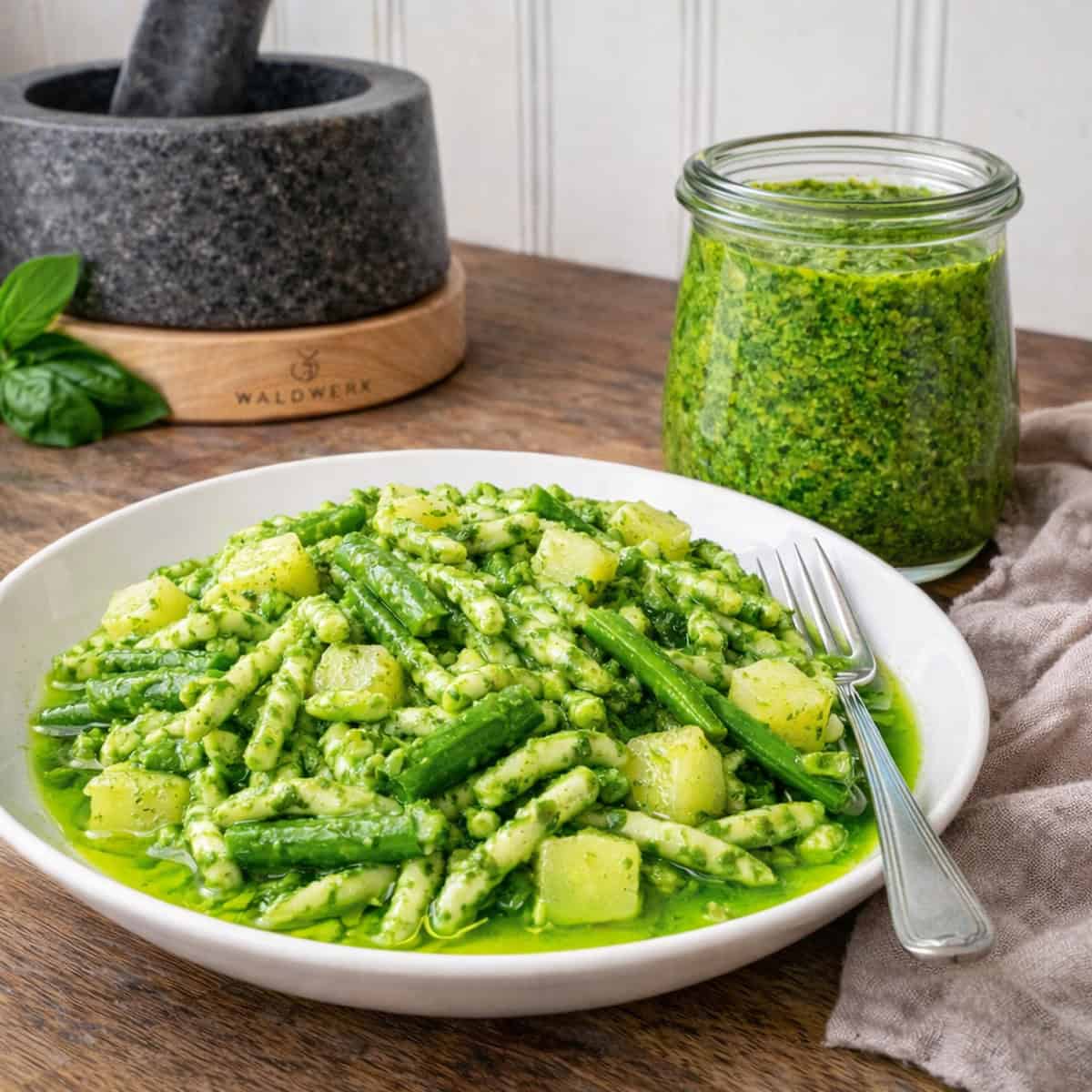
It exists because basil grows aggressively along the Ligurian coast, and someone figured out how to turn that abundance into dinner using almost no heat and very little force. The restraint is the technique.
When pesto goes wrong, it’s almost always because someone rushed it, overheated it, or tried to make it do more than it was ever meant to do. When it goes right, it tastes like summer pressed into a bowl and stopped just in time.
This version isn’t precious, but it is deliberate. It’s about temperature, timing, and knowing when to stop.
Ingredient Intelligence
Basil
Basil isn’t just the star — it’s the whole orchestra.
Young Genovese basil is ideal: small leaves, tender stems, no bitterness. Larger grocery-store basil can work if it’s fresh and cool. Warm basil bruises quickly, and bruised basil tastes flat and dull.
If tearing a leaf releases a sweet, green aroma, you’re in good shape. If it smells grassy or metallic, don’t proceed.
Garlic
Garlic should whisper, not announce itself.
One small clove is plenty. Pesto isn’t garlic sauce. Raw garlic gets louder the longer it’s processed, which is why it needs to be cut gently and introduced early, then left alone.
Pine Nuts
Pine nuts give pesto body and softness.
They don’t crunch. They don’t shout. They round out the basil and help carry the oil. Raw pine nuts keep the flavor sweet and clean. Toasting is optional, but if you do it, barely take them to color.
Burnt pine nuts ruin everything they touch.
Cheese
This is not a one-cheese job.
Parmigiano Reggiano brings depth and umami. Pecorino brings salt and edge. Together, they give pesto structure without overpowering the basil. Pre-grated cheese won’t emulsify properly and tends to taste dusty.
This is not the place to cut corners.
Olive Oil
Olive oil is the binder, not the headline.
You want a mild, fruity extra virgin olive oil — nothing bitter or aggressively peppery. Strong oils fight basil instead of supporting it. Add the oil slowly and stop when the pesto turns glossy and loose.
If it looks shiny and wet, you’ve gone too far.
Salt
Salt sharpens everything and helps break down the basil.
Add a little early. Finish carefully. The cheese will do more seasoning than you think.
Technique Intelligence
Pesto isn’t blended — it’s assembled.
The goal is to rupture basil just enough to release aroma without generating heat. Heat dulls basil. Speed creates heat. Over-processing destroys texture. That’s why pesto can go from vibrant to swampy in seconds if you’re not paying attention.
Whether you use a mortar or a food processor, the principle is the same:
work cold, work briefly, stop early.
If you’re wondering whether it needs another pass, it doesn’t.
Wine Pairing
Pesto Genovese comes from Liguria, where the food is aromatic but restrained and the wines are built to refresh rather than dominate. The classic pairing is Vermentino from the Ligurian coast—bright, saline, and herbal enough to echo basil without competing with it.
Another traditional choice is Pigato, Liguria’s local expression of Vermentino. It carries slightly more texture and bitterness, which works well with potatoes and green beans folded into the pasta.
If you step outside the region, look for whites with high acidity and minimal oak: a dry Soave, Verdicchio, or even a lean Grüner Veltliner. What matters is lift. Anything heavy or buttery will smother the sauce.
Red wine generally doesn’t belong here. This dish lives in the space between land and sea, and the wine should stay there too.
Mortar vs Food Processor
A mortar produces the most aromatic pesto. Crushing basil slowly releases oils gently and keeps flavors distinct. There’s no argument there.
A food processor works when treated with discipline: a chilled bowl, short pulses, and restraint. Continuous blending overheats the basil and flattens the flavor. Smooth pesto isn’t a goal — it’s a warning sign.
Pesto Genovese

Equipment
- Equipment
- Rubber spatula
- Small mixing bowl
Ingredients
Ingredients
- 2 packed cups fresh basil leaves about 40–50 g
- 1 small garlic clove peeled
- 2 tablespoons pine nuts
- ½ teaspoon fine sea salt plus more to taste
- ½ cup extra virgin olive oil divided
- ¼ cup finely grated Parmigiano Reggiano
- 2 tablespoons finely grated Pecorino Romano
Instructions
Instructions
Method 1: Mortar & Pestle (Preferred)
- Add ½ teaspoon fine sea salt and 1 small garlic clove to a mortar. Grind until the garlic forms a smooth paste.
- Add 2 tablespoons pine nuts and crush until creamy and cohesive.
- Add 2 packed cups basil leaves a handful at a time, grinding gently with a circular motion until the leaves break down and release their aroma.
- Drizzle in ¼ cup extra virgin olive oil, working it in slowly until the mixture loosens and turns glossy.
- Transfer the mixture to a bowl and fold in ¼ cup Parmigiano Reggiano and 2 tablespoons Pecorino Romano.
- Add the remaining ¼ cup olive oil gradually until the pesto is loose but not watery.
- Taste and adjust salt if needed. The pesto should be aromatic, textured, and vibrant.
Method 2: Food Processor (Modern Alternative)
- Place the food processor bowl and blade in the refrigerator for 10 minutes to chill.
- Add 1 small garlic clove, 2 tablespoons pine nuts, and ½ teaspoon fine sea salt to the bowl. Pulse 3–4 times until finely chopped.
- Add 2 packed cups basil leaves and pulse briefly just until broken down. Do not run the machine continuously.
- With the machine off, drizzle in ¼ cup extra virgin olive oil, pulsing only until combined.
- Transfer the mixture to a bowl and fold in ¼ cup Parmigiano Reggiano and 2 tablespoons Pecorino Romano by hand.
- Add the remaining ¼ cup olive oil gradually, stirring gently until the pesto reaches a spoonable consistency.
- Taste and adjust salt if needed.
Notes
Equipment You’ll Need
Mortar & Pestle (Traditional Option)
The gold standard.
A stone mortar allows you to crush basil slowly without heat, producing a textured, aromatic pesto that tastes alive.
Food Processor (Modern Option)
Completely acceptable — if you’re careful.
Use short pulses only and stop as soon as the pesto comes together. Speed and friction are the enemy here.
Microplane or Fine Grater
Cheese needs to melt into the pesto, not sit on top of it. A fine grate ensures clean emulsification.
Chef’s Knife
For garlic — and nothing else.
Garlic should be cut cleanly, not smashed into paste before the basil enters the picture.
Rubber Spatula
For scraping, not stirring.
Pesto should be moved gently to preserve texture.
Small Mixing Bowl
Useful for finishing by hand, especially when folding in oil or cheese after processing.
Airtight Container
Pesto oxidizes quickly.
Choose a container that allows you to press wrap directly onto the surface to protect color and aroma.
How to Use Pesto
Pesto should never be cooked.
Add it off heat, loosened with a little pasta water if needed. It shines with:
- Fresh pasta such as trofie, trenette, or tagliatelle
- Potatoes and green beans folded into pasta, Ligurian-style
- Warm focaccia, spread thin
- A spoonful stirred into soup just before serving
If you fry it, simmer it, or bake it, you’ve missed the point.
Storage
Press parchment or plastic wrap directly onto the surface and refrigerate.
Pesto keeps for 2–3 days cold. It freezes well in small portions. The color fades slightly, but the flavor holds — and flavor is what matters.

Comments
No Comments