
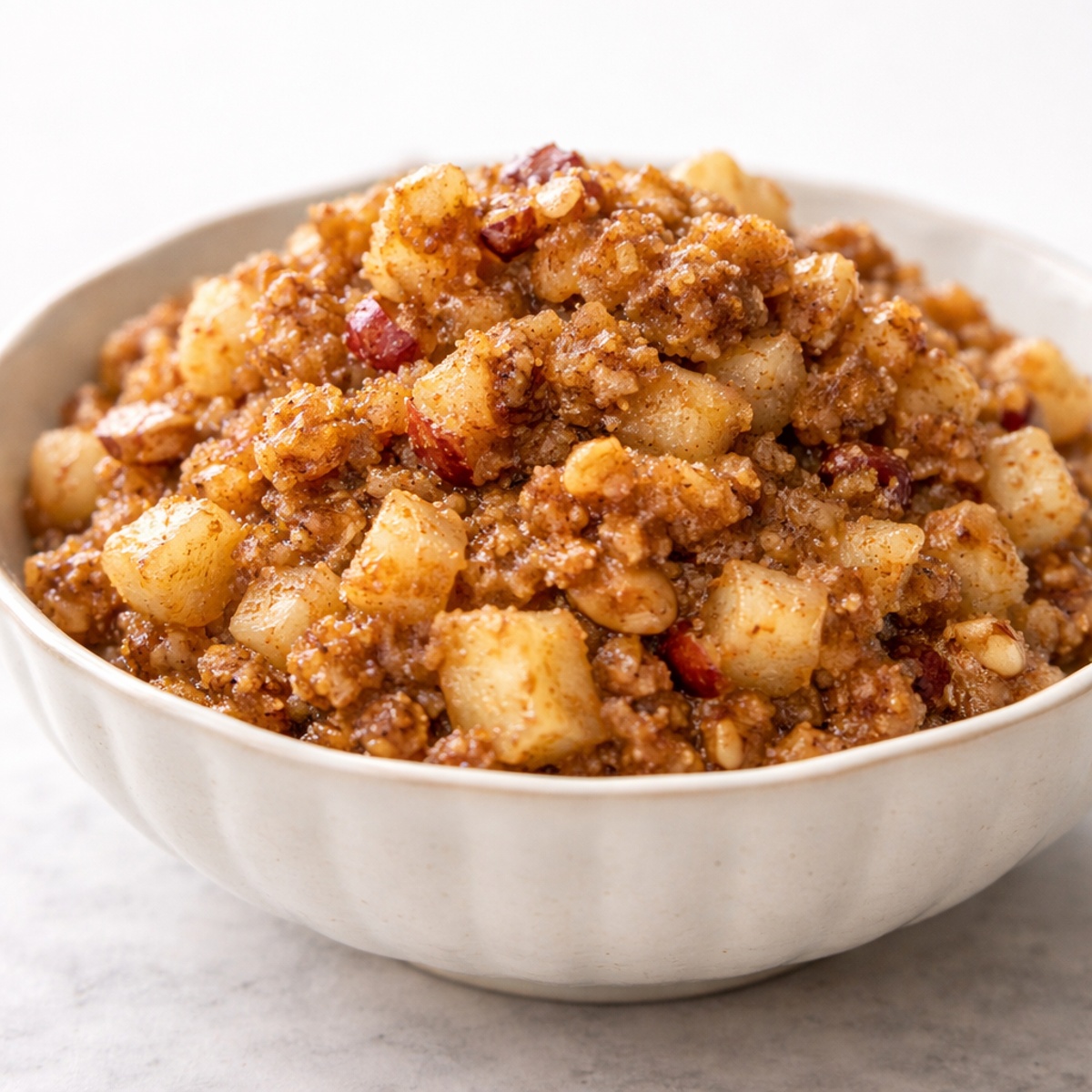
Sweet, Sharp, and Textured — The Balance That Holds the Table Together
Charoset is one of the few dishes on the table that feels immediate.
No long cooking. No transformation in the oven. Just a handful of ingredients brought together at the last moment—fresh, bright, and alive in a way the rest of the meal isn’t.
And that’s exactly why it matters.
Between the richness of the brisket, the depth of the soup, and the weight of everything that comes before it, charoset resets the palate. It cuts through, wakes things up, and keeps the meal moving.
When it’s right, you don’t think about it—you just keep going back for another bite.
Technique Intelligence
Charoset isn’t cooked, but it still requires control.
This is about balance and texture, not assembly.
The apples bring freshness and acid, but they start oxidizing the moment they’re cut. The nuts add structure, but if they’re too fine, the mixture loses its identity. The wine and sweetener tie everything together—but push them too far, and it turns heavy instead of bright.
Most mistakes come from overworking it.
Charoset should feel loose, slightly coarse, and just held together—not blended, not puréed, not uniform.
You’re not making a paste.
You’re building contrast.
Ingredient Intelligence
Charoset looks simple, but each ingredient carries more weight than it seems. The balance is subtle, and once it tips too far in any direction, you feel it immediately.
Apples
The apples are the backbone.
They bring sweetness, acidity, and structure all at once. But they also begin to change the second they’re cut. Oxygen hits the surface, and they start to brown, soften, and lose that clean edge.
The variety matters. A firmer apple holds texture longer and keeps the mixture from collapsing into something soft. A sweeter apple shifts the balance, sometimes more than you expect.
Cut too small, and they disappear. Too large, and the mixture feels disjointed.
There’s a moment where they’re just right—fresh, crisp, and integrated without losing themselves.
Walnuts
Walnuts give charoset its structure.
They bring a slight bitterness and a soft crunch that balances the sweetness of the apples. But they need to be handled carefully. Chop them too fine, and they vanish into the mixture. Leave them too large, and they overpower each bite.
They should be present, but not dominant—something you notice, not something you fight.
Wine
Wine ties everything together.
Traditionally, it’s red—something with enough body to carry through the apples and nuts without overwhelming them. It adds depth and a slight acidity that rounds out the sweetness.
Too little, and the mixture feels dry. Too much, and it turns loose and heavy.
It’s not there to stand out—it’s there to connect.
Sweetener (Honey or Sugar)
Sweetness is already coming from the apples, but it usually needs a little support.
Honey adds depth and a softer sweetness. Sugar is more direct. Either works—but both need restraint.
Too much, and the charoset loses its balance. It stops refreshing the palate and starts weighing it down.
Cinnamon
A small amount goes a long way.
It adds warmth and familiarity, but it should sit in the background. If you taste cinnamon first, you’ve gone too far.
Equipment
- Chef’s knife (for controlled chopping)
- Cutting board
- Mixing bowl
- Spoon or spatula
Optional:
- Food processor (pulse carefully, don’t purée)
Storage
Refrigeration:
Store covered for up to 2 days.
Best the day it’s made.
Oxidation note:
Apples will darken over time. This is natural and doesn’t affect flavor significantly, but texture softens slightly.
Serving Notes
Serve slightly chilled or at room temperature.
Used:
- with maror (horseradish)
- in the Hillel sandwich (matzo + maror + charoset)
- alongside the meal as a contrast element
This is not a side dish in the traditional sense—it’s a reset between bites.
FAQ
Should charoset be smooth or chunky?
Chunky. Always. If it’s smooth, you’ve lost the texture.
Can I make it ahead?
Yes—but same day is best for texture and brightness.
What apples are best?
Firm, balanced apples. Too soft and it collapses, too sweet and it loses contrast.
Can I use a food processor?
Yes—but pulse carefully. One step too far and it becomes paste.
Why does mine turn watery?
Too much liquid or overprocessed apples breaking down.
Apple–Walnut Charoset

Equipment
- Chef’s knife
- Mixing bowl
- Spoon or spatula
Ingredients
- 3 medium apples peeled, cored, and finely chopped
- ¾ cup walnuts coarsely chopped
- ¼ cup dry red wine
- 2 tablespoons honey or sugar
- ½ teaspoon ground cinnamon
- Pinch kosher salt
Instructions
- Peel, core, and finely chop 3 medium apples into small, even pieces.
- Coarsely chop ¾ cup walnuts, keeping some texture.
- In a mixing bowl, combine the apples and walnuts.
- Add ¼ cup red wine, 2 tablespoons honey or sugar, ½ teaspoon cinnamon, and a pinch of kosher salt.
- Mix gently until everything is evenly coated and just held together.
- Taste and adjust sweetness or wine slightly if needed.
- Let sit for 10–15 minutes before serving to allow flavors to come together.
Notes
Keep the texture slightly coarse—do not overmix or purée.
Use a firm apple to maintain structure.
Wine should lightly coat, not saturate the mixture.
Best made the same day for freshness and texture.
Comments
No Comments