
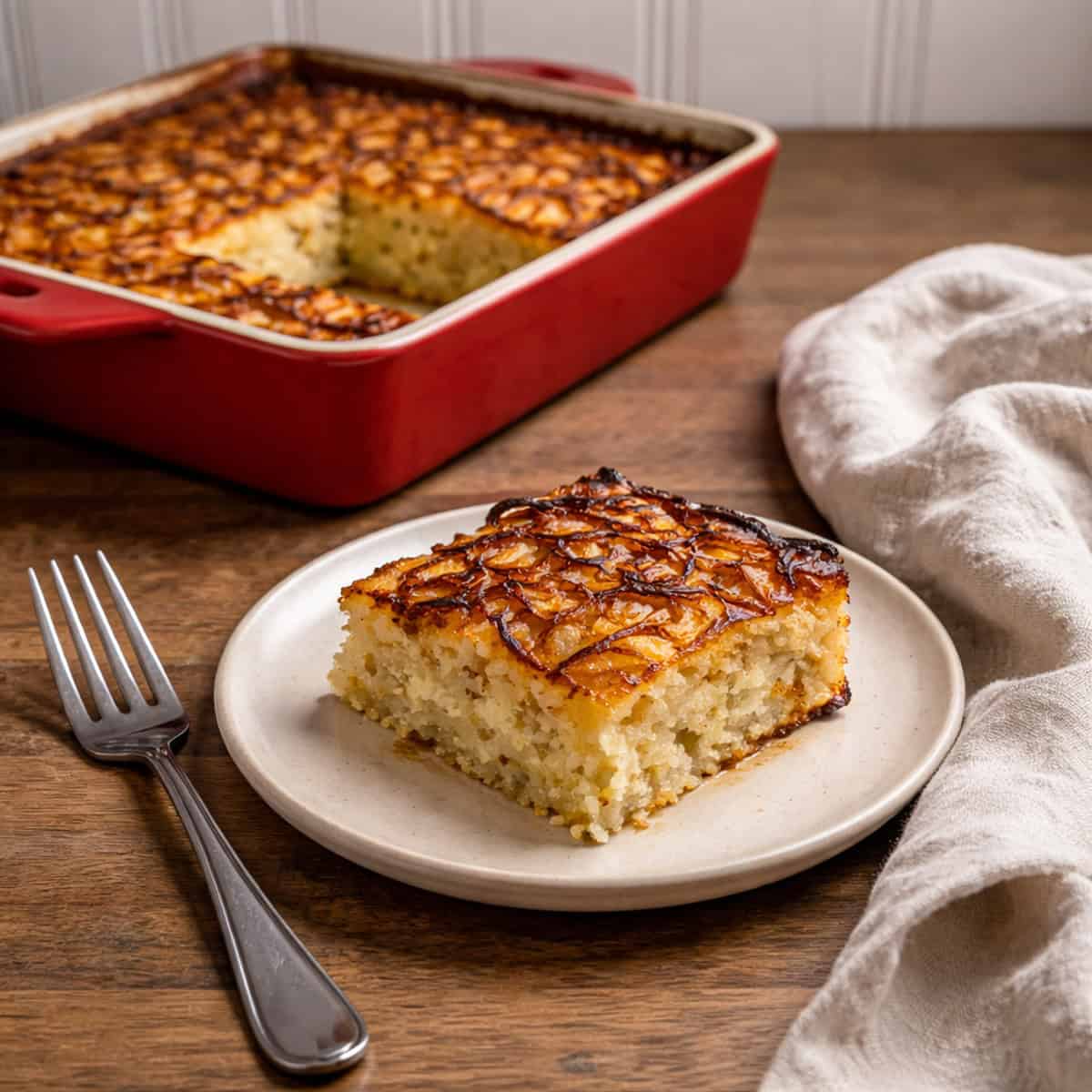
Structure Without Flour — How to Control Texture the Right Way
Potato kugel looks simple. It isn’t. Done right, it’s all contrast—a deeply golden, crisp top that gives way to a soft, almost custardy center. Done wrong, it’s dense, gray, and forgettable.
This isn’t about ingredients. It’s about how you handle them.
Technique Intelligence
Kugel lives and dies on starch control and moisture balance.
You’re working with grated potatoes for structure, eggs for binding, and fat to create a crust that should feel closer to fried than baked.
The failure point is almost always water. Too much moisture, and the kugel steams instead of setting. Too little control, and the interior tightens before the crust develops.
And then there’s the pan.
If the fat isn’t hot before the mixture hits, you’ve already lost the crust. That initial sizzle is what sets the edges and builds structure from the outside in. You’re not baking a mixture. You’re building a crust around it.
Ingredient Intelligence
Potato kugel doesn’t rely on many ingredients—which is exactly why each one matters more than you think. There’s nowhere to hide here.
Potatoes
Everything starts with the potatoes.
Russets are non-negotiable—high starch, low moisture, and just enough structure to hold everything together without becoming heavy. The moment you grate them, they begin to release starch and water. Let them sit too long, and they discolor and tighten. Handled properly, they give you that soft, almost custardy center. Handled carelessly, they turn dense or gluey. The difference isn’t the ingredient—it’s how quickly and intentionally you move.
Onion
The onion does quiet work. Grated instead of chopped, it disappears into the mixture, releasing moisture gradually as it cooks. That moisture creates steam inside the kugel, softening the interior while the exterior sets and crisps.
Eggs
Without flour, the eggs carry the structure.
They bind, but they also lighten—if you let them. Too few and the kugel won’t hold. Too many and it tightens, losing that tender interior. They need to be mixed just enough to integrate, not overworked. Handled gently, they lift. Handled poorly, they weigh everything down.
Fat (Schmaltz or Oil)
Fat is what creates the crust—and the crust is the whole point. When the mixture hits hot fat, it should sizzle immediately. That contact sets the edges and begins building that deep golden exterior. Schmaltz (rendered chicken fat) adds depth and flavor that fits naturally with the dish. Oil works, but it’s neutral—more function than character. Either way, if the fat isn’t hot, the kugel steams. And once it steams, you don’t get that crust back.
Salt and Pepper
Simple, but critical. Potatoes absorb seasoning more than you expect. Under-season, and the entire dish tastes flat no matter how well it’s cooked. Salt brings clarity. Pepper adds just enough edge to keep it from feeling one-dimensional.
Equipment
- Box grater or food processor (coarse grate)
- Large mixing bowl
- Clean kitchen towel or cheesecloth (for squeezing moisture)
- 9x13 baking dish or cast iron pan
- Oven (consistent 400°F heat)
Optional but useful:
- Spider or slotted spoon (for handling mixture cleanly)
- Scale (for consistency batch to batch)
Storage & Reheating
Refrigeration:
Store covered up to 3 days.
Reheating:
Reheat in a 375°F oven, uncovered, until heated through and the top re-crisps.
Avoid the microwave—it softens the crust and ruins the texture.
Freezing:
Possible, but not ideal. The texture softens on thaw.
If freezing, reheat uncovered in the oven to restore structure.
Serving Notes
Slice into clean squares or wedges.
It should hold its shape but remain tender inside.
Pairs naturally with:
- braised brisket
- roasted vegetables
- any rich, slow-cooked protein
FAQ
Why is my kugel dense?
Too much moisture or overmixing. The potatoes likely weren’t drained properly.
Why didn’t I get a crispy top?
Your fat wasn’t hot enough before adding the mixture.
Can I make this ahead?
Yes—and you should. Bake it, cool it, then reheat to serve. The structure actually improves.
Do I need schmaltz?
No—but it’s better. Oil works, schmaltz adds flavor that belongs here.
Why did it turn gray?
Oxidation. The potatoes sat too long before cooking.
Internal Link
👉 Pair with: Passover Seder Menu (Traditional Recipes and What to Serve)
Final Note
Kugel isn’t complicated—but it is exacting.
There are only a few ingredients, and each one behaves in ways that are easy to overlook if you’re not paying attention.
Get those details right, and the dish does exactly what it’s supposed to do—
simple, structured, and quietly satisfying.
Potato Kugel (Crisp Top, Custardy Center)

Equipment
- Box grater or food processor with coarse grating attachment
- Large mixing bowl
- Clean kitchen towel or cheesecloth
- 9x13 baking dish or 12-inch cast iron skillet
- Oven
Ingredients
- 2 ½ pounds russet potatoes peeled
- 1 large yellow onion peeled
- 3 large eggs
- ⅓ cup schmaltz or neutral oil plus more if needed for the pan
- 1 ½ teaspoons kosher salt
- ½ teaspoon black pepper
- 1 tablespoon potato starch optional
Instructions
- Preheat the oven to 400°F.
- Add ⅓ cup schmaltz or neutral oil to a 9x13 baking dish or 12-inch cast iron skillet and place it in the oven to heat while you prepare the kugel mixture.
- Using a box grater or food processor, grate 2 ½ pounds peeled russet potatoes and 1 large yellow onion.
- Transfer the grated potatoes and onion to a clean kitchen towel or cheesecloth and squeeze out as much excess moisture as possible.
- Place the drained potato and onion mixture in a large mixing bowl.
- Add 3 large eggs, 1 ½ teaspoons kosher salt, ½ teaspoon black pepper, and 1 tablespoon potato starch, if using. Mix just until combined.
- Carefully remove the hot baking dish or skillet from the oven. The fat should be shimmering.
- Spread the potato mixture into the hot pan. It should sizzle as it hits the fat.
- Return the pan to the oven and bake for 50 to 60 minutes, until the top is deeply golden brown, the edges are crisp, and the center is set but still tender.
- Let the kugel rest for 10 to 15 minutes before slicing and serving.
Notes
Russet potatoes are the right choice here. Their higher starch content helps create structure and a more custardy interior.
Squeezing out excess moisture is critical. Too much water will steam the kugel instead of allowing it to set and crisp properly.
Schmaltz gives the best flavor, but neutral oil works well if needed.
For the best crust, make sure the fat is fully hot before the potato mixture goes into the pan.
Comments
No Comments