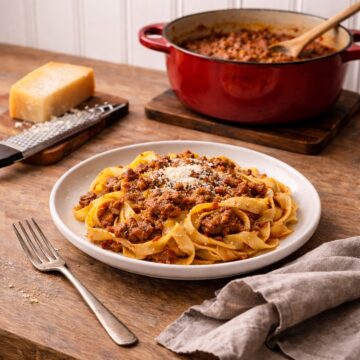
Bolognese (Ragù alla Bolognese)

A classic ragù alla Bolognese built on properly browned meat, a gentle soffritto, milk, white wine, and slow simmering to develop depth and balance.
Ingredients
Ingredients
Meat
- 1 lb ground beef
- ½ lb ground pork
Soffritto
- 1 onion finely diced
- 1 carrot finely diced
- 1 celery stalk finely diced
Liquids & Fat
- 2 tablespoons olive oil
- 2 tablespoons butter
- 1 cup whole milk
- 1 cup dry white wine
Tomato
- 2 tablespoons tomato paste
- Optional: ½ cup crushed tomatoes
Seasoning
- Kosher salt
- Freshly ground black pepper
To Finish
- Fresh tagliatelle for serving
- Parmigiano-Reggiano grated
Instructions
Instructions
Build the Base
- Heat 2 tablespoons olive oil and 2 tablespoons butter in a heavy-bottomed pot over medium heat until the butter melts and the oil shimmers quietly.
- Add 1 finely diced onion, 1 finely diced carrot, and 1 finely diced celery stalk, along with a pinch of kosher salt. The vegetables should sizzle gently.
- Cook for 10–12 minutes, stirring occasionally, until the vegetables soften and turn translucent. They should smell sweet and vegetal, with no browning at the edges.
Brown the Meat Properly
- Increase the heat to medium-high and add 1 lb ground beef and ½ lb ground pork. You should hear a confident sizzle when the meat hits the pot.
- Spread the meat into an even layer and leave it undisturbed for several minutes so it can brown properly.
- As the moisture cooks off, the aroma deepens and brown bits begin to form on the bottom of the pot. This is what you want.
- Break up the meat and continue cooking until it’s well browned and slightly crisp in places, with no visible liquid remaining.
- Scrape the bottom of the pot to release the browned bits — they should lift easily and smell roasted, not burnt.
Build the Sauce
- Stir in 2 tablespoons tomato paste and cook for 2–3 minutes, scraping the pot as you go, until the paste darkens slightly and loses its raw edge.
- Pour in 1 cup dry white wine and let it simmer until fully reduced. The sharp alcohol smell should disappear, leaving behind a savory glaze.
- Add 1 cup whole milk and lower the heat. Let it cook gently until it’s fully absorbed and no longer visible, softening the meat and rounding the sauce.
- Season lightly with kosher salt and freshly ground black pepper.
Slow Simmer
- Add ½ cup crushed tomatoes, if using. The sauce should remain meat-forward, not red.
- Reduce the heat to low and let the ragù simmer uncovered for 2–3 hours, stirring occasionally. You’re looking for slow, lazy bubbles and a sauce that gradually thickens and comes together.
- Taste and adjust seasoning. At this point, the flavor should be deep, savory, and settled, with nothing sharp sticking out.
Serve
- Spoon the ragù over fresh tagliatelle or toss gently with pasta until it clings without pooling.
- Finish with freshly grated Parmigiano-Reggiano and serve right away.
Notes
Chef Notes
The meat should be deeply browned and slightly crispy before any liquids are added.
If the meat steams instead of browns, the heat is too low or the pot is overcrowded.
Fond on the bottom of the pot is not burning — it’s flavor. Scrape it deliberately.
Milk goes in before wine to protect texture and round the sauce.
Storage
Refrigerate for up to 4 days.
Freeze for up to 3 months.
Flavor improves after resting overnight.
Tried this recipe?Let us know how it was!
