
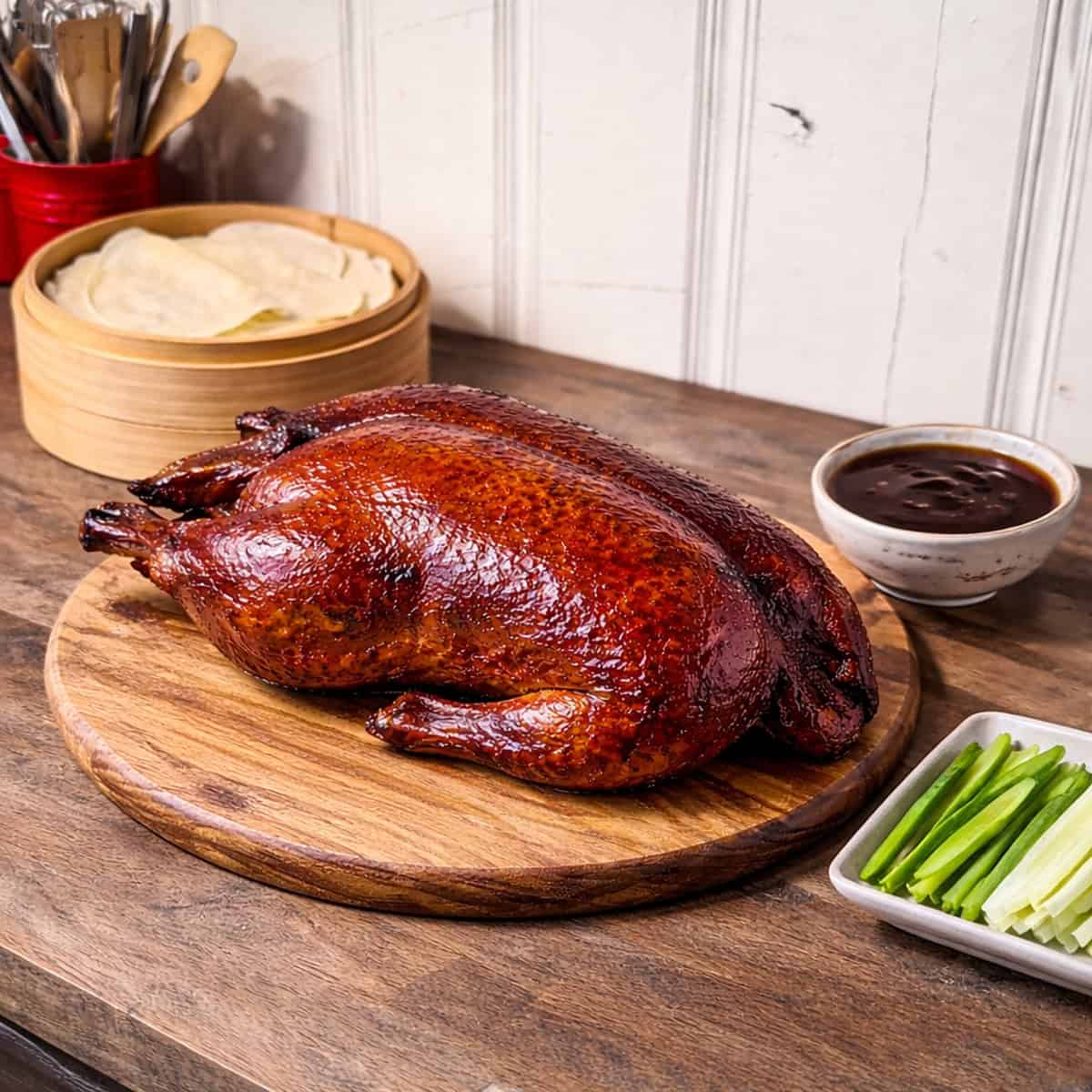
The first time you eat proper Peking Duck, you don’t think about flavor. You think about sound.
The skin cracks when it’s cut. Not crunches — cracks.
The room goes quiet for a second, because that sound means the hard part was done days ago.
Peking Duck isn’t a roast duck recipe. It’s a system replies on air, heat, and time.
Instead, the work happens before the bird ever sees the oven. As a result, flavor is deliberately restrained so texture can take the lead. Nothing is rushed. Nothing is loud.
北京烤鸭 comes from Beijing, where it evolved in professional kitchens designed for hanging birds, open flames, and controlled airflow.
Home cooks adapt the method, not the intent. The goal is always the same: skin so crisp it barely remembers the duck it came from.
What Peking Duck Is Really About
Peking Duck isn’t about spice.
It’s about engineering crispness.
You’re managing:
- Skin separated from fat
- Surface tightened and dehydrated
- Fat rendered slowly away
- High, even heat at the end
The pancakes, sauces, and garnishes exist to support the texture — not distract from it.
Ingredient Intelligence(原料逻辑)
Duck(鸭子)
A whole duck with intact skin is essential. Duck is fatty by nature — that’s the asset — but only if that fat is rendered away from the skin. Size matters less than skin quality. You’re cooking the surface as much as the bird.
Boiling Water(热水)
This is the step most shortcuts skip — and the step that makes everything else possible. Pouring boiling water over the skin tightens it instantly, shrinking it away from the fat underneath. This sets the stage for proper drying and clean rendering later.
Air(空气)
Meanwhile, air remains the quiet ingredient no one talks about. After the skin is tightened, it must be dried completely. Moisture is the enemy of crispness. Without a long, uncovered dry, the duck steams instead of crackling.
Maltose or Honey Glaze(麦芽糖 / 蜂蜜)
The glaze isn’t for sweetness. It’s for sheen and structure. Maltose dries hard and clear, creating that lacquered finish. Honey works at home, but browns faster and requires restraint.
Vinegar(醋)
Added to the glaze to tighten the skin further and cut residual fat. You should never taste it. Its role is structural, not flavorful.
Aromatics(香料)
Ginger, scallions, and sometimes star anise are tucked loosely into the cavity. They gently perfume the meat without interfering with the skin. Airflow still matters — overstuffing works against you.
Technique Intelligence: Why Peking Duck Takes Two Days
(技术关键)
Peking Duck works because cooks treat the skin as a separate component — and because time is allowed to do its job.
On day one, the skin is tightened with boiling water, glazed, and dried.
On day two, the now-dry skin is exposed to high heat so fat renders away and the surface dehydrates into something brittle and light.
When the skin is wet, it steams.
Without proper rendering, it softens.
Rushed drying causes blistering instead of shattering.
Crisp duck skin isn’t luck. It’s physics, practiced patiently.
Peking duck is defined by contrast: crackling skin, rich fat, subtle sweetness, and clean pancakes. The wine needs acidity and precision more than power.
A Brut sparkling wine is one of the best matches. The bubbles cut through rendered fat, reset the palate between bites, and stay neutral enough to let the duck and condiments lead. Look for dry styles with good acidity rather than overt fruit.
For still wine, Pinot Noir works well when it’s light, restrained, and low in oak. The gentle red fruit complements the duck without clashing with hoisin or scallion.
A dry or slightly off-dry Riesling is another strong option, especially when sweetness is more pronounced. Its acidity balances fat, and a touch of residual sugar mirrors the glaze without tipping the dish out of balance.
Avoid heavily tannic reds or wines with aggressive oak. Crisp skin and clean flavors leave nowhere for heaviness to hide.
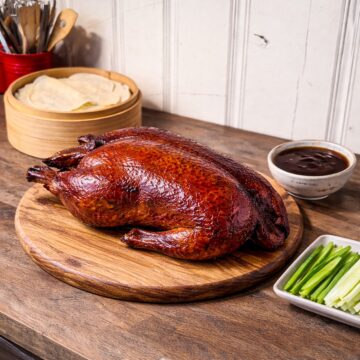
Peking Duck(北京烤鸭)

Ingredients
Ingredients
- 1 whole duck 5–6 lb, cleaned
- 1 teaspoon salt
Skin Glaze
- 3 tablespoons maltose or honey
- 2 tablespoons hot water
- 2 tablespoons rice vinegar
Aromatics (for stuffing the cavity)
- 4 –5 slices fresh ginger
- 2 –3 scallions cut into large segments
- 1 small shallot halved (optional)
- 1 small star anise optional
For Serving
- Mandarin pancakes(薄饼)
- Scallions finely sliced
- Cucumber julienned
- Sweet bean sauce or hoisin(甜面酱)
Instructions
Instructions
Day 1: Prepare and Air-Dry the Duck
- Pat the duck completely dry with kitchen paper. Rub salt evenly over the skin and inside the cavity.
- Place the duck on a wire rack set over a tray and let rest at room temperature for 1 hour.
- Bring 1½ liters (6 cups) of water to a rolling boil. Carefully pour the hot water evenly over the duck skin, flipping to treat both sides.
- Remove any remaining feather ends with tweezers while the skin is hot.
- Stuff the cavity loosely with ginger, scallions, shallot, and star anise. Do not overfill.
- In a bowl, dissolve maltose with hot water and vinegar until fully liquid.
- Brush a thin, even layer of glaze over the duck skin.
- Refrigerate the duck uncovered for 1 hour, then brush on a second thin layer of glaze.
- Return the duck to the refrigerator, uncovered, on the rack and tray, and air-dry for 24–48 hours, until the skin is completely dry and taut.
Day 2: Roast the Duck
- Preheat oven to 425°F (220°C).
- Roast the duck on a rack set over a pan for 30 minutes.
- Reduce oven temperature to 350°F (175°C) and continue roasting until the skin is deep golden and crisp and internal temperature reaches 165°F, about 45–60 minutes.
- Rest the duck for 10 minutes before carving.
- Serve with pancakes, scallions, cucumber, and sauce.
Notes
Reheat in a hot oven to re-crisp skin or use remaining meat for stir-fries or soup.
Common Misunderstandings(常见误解)
- “It’s just a roast duck.”
It isn’t. Roast duck celebrates meat. 北京烤鸭 celebrates skin. - “The glaze makes it sweet.”
It shouldn’t. Sweetness means the balance slipped. - “You can skip the boiling water or drying.”
You can — but you’ll be making something else.
Serving Intelligence: How 北京烤鸭 Is Meant to Be Eaten
(食用方式)
Diners eat Peking Duck deliberately, one bite at a time.
Classic Accompaniments(传统配菜)
- Mandarin pancakes(薄饼) – soft, warm, neutral
- Sweet bean sauce or hoisin(甜面酱) – savory-sweet, used sparingly
- Scallions & cucumber(葱丝、黄瓜) – freshness and crunch
Each bite should feel balanced: crisp skin, soft pancake, a hint of sweetness, something fresh to reset the palate.
If the duck overwhelms everything else, the table’s out of tune.
What Happens to the Rest of the Duck
(余料处理)
Traditionally, the carved meat doesn’t disappear. It’s put to work. Stir-fried, turned into soup, or served simply with salt. Respect for the bird doesn’t stop once the skin is gone.
Waste has never been part of the tradition.
Comments
No Comments