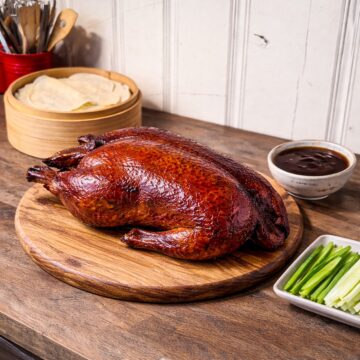
Peking Duck(北京烤鸭)

A traditional Beijing-style roast duck made over two days using boiling water to tighten the skin, maltose glazing, overnight air drying, and high-heat roasting to achieve crisp skin and balanced flavor.
Ingredients
Ingredients
- 1 whole duck 5–6 lb, cleaned
- 1 teaspoon salt
Skin Glaze
- 3 tablespoons maltose or honey
- 2 tablespoons hot water
- 2 tablespoons rice vinegar
Aromatics (for stuffing the cavity)
- 4 –5 slices fresh ginger
- 2 –3 scallions cut into large segments
- 1 small shallot halved (optional)
- 1 small star anise optional
For Serving
- Mandarin pancakes(薄饼)
- Scallions finely sliced
- Cucumber julienned
- Sweet bean sauce or hoisin(甜面酱)
Instructions
Instructions
Day 1: Prepare and Air-Dry the Duck
- Pat the duck completely dry with kitchen paper. Rub salt evenly over the skin and inside the cavity.
- Place the duck on a wire rack set over a tray and let rest at room temperature for 1 hour.
- Bring 1½ liters (6 cups) of water to a rolling boil. Carefully pour the hot water evenly over the duck skin, flipping to treat both sides.
- Remove any remaining feather ends with tweezers while the skin is hot.
- Stuff the cavity loosely with ginger, scallions, shallot, and star anise. Do not overfill.
- In a bowl, dissolve maltose with hot water and vinegar until fully liquid.
- Brush a thin, even layer of glaze over the duck skin.
- Refrigerate the duck uncovered for 1 hour, then brush on a second thin layer of glaze.
- Return the duck to the refrigerator, uncovered, on the rack and tray, and air-dry for 24–48 hours, until the skin is completely dry and taut.
Day 2: Roast the Duck
- Preheat oven to 425°F (220°C).
- Roast the duck on a rack set over a pan for 30 minutes.
- Reduce oven temperature to 350°F (175°C) and continue roasting until the skin is deep golden and crisp and internal temperature reaches 165°F, about 45–60 minutes.
- Rest the duck for 10 minutes before carving.
- Serve with pancakes, scallions, cucumber, and sauce.
Notes
Chef Notes
Boiling water tightens the skin and is essential for proper rendering.
Air drying is not optional; the skin must be fully dry before roasting.
Maltose produces the most traditional lacquered finish; honey browns faster and requires closer monitoring.
Aromatics should perfume the meat without blocking airflow inside the cavity.
Storage
Refrigerate leftover duck for up to 3 days.
Reheat in a hot oven to re-crisp skin or use remaining meat for stir-fries or soup.
Reheat in a hot oven to re-crisp skin or use remaining meat for stir-fries or soup.
Tried this recipe?Let us know how it was!
