
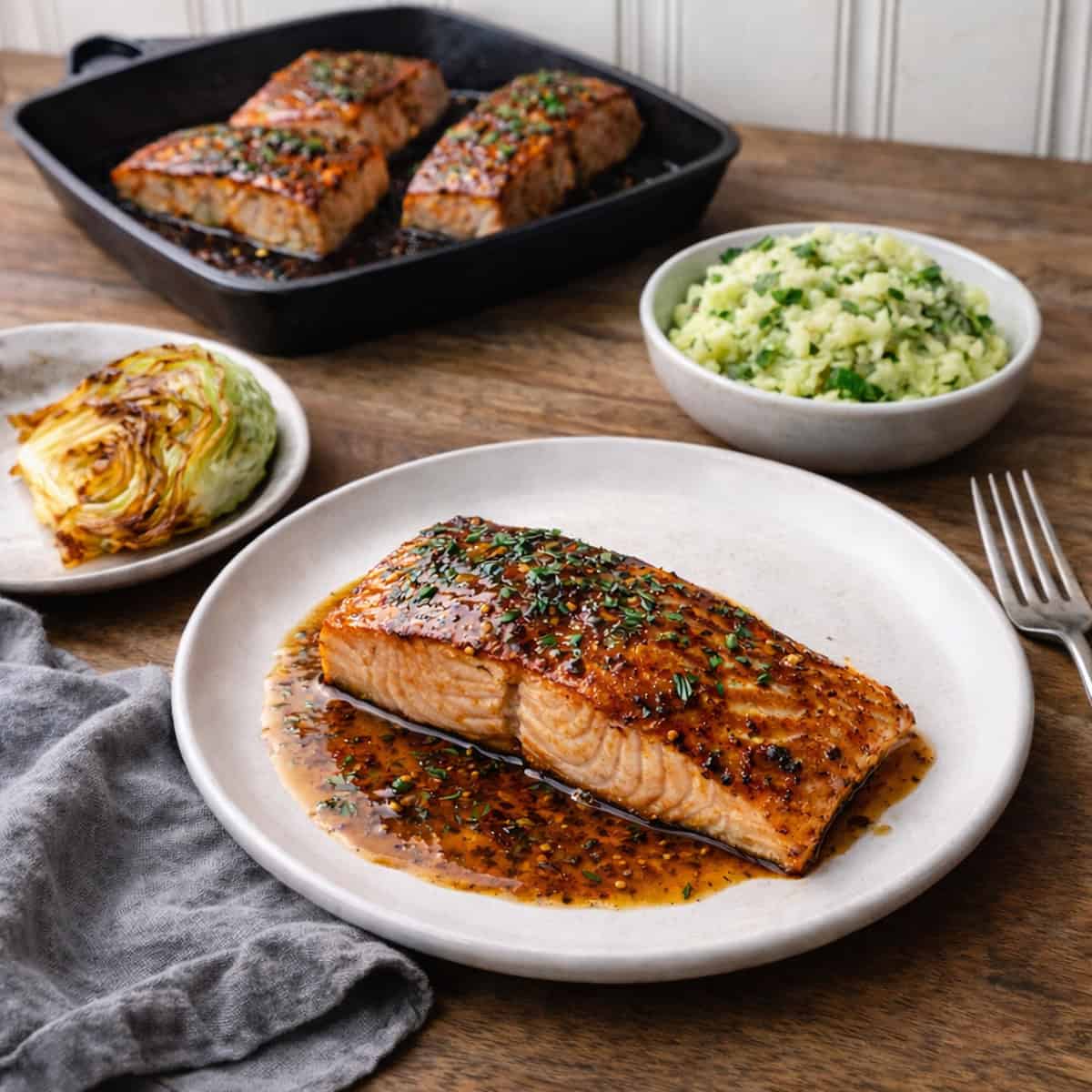
Ireland’s cooking rarely hides behind complexity. Good fish, hot pan, butter, something sharp to cut the richness. That’s the whole game.
Simple ingredients. Strong flavors. No nonsense.
Why This Dish Works
Salmon is naturally rich, so the sauce needs to lift it, not overwhelm it.
The fish goes into a properly hot pan so the skin crisps and turns golden. That first step builds the foundation of the dish.
A splash of Irish whiskey deglazes the pan, lifting the browned bits and bringing warm caramel notes to the sauce. Whole grain mustard adds gentle heat and acidity, while honey rounds the edges and helps the glaze cling lightly to the fish.
At the end, a knob of butter melts into the reduction, turning it silky and glossy.
The result is balanced and quietly satisfying — crisp salmon, a bright whiskey glaze, and flavors that feel both comforting and just a little celebratory.
What You’ll Be Doing
You’ll sear skin-on salmon in a hot pan to develop crisp skin and gentle browning. After the fish is removed, Irish whiskey deglazes the skillet and lifts the caramelized fond. Mustard and honey are whisked in and reduced slightly, then finished with butter to create a smooth glaze.
The salmon is returned briefly to the pan and coated in the sauce before serving.
Technique Intelligence
Drying the Salmon -Moisture prevents proper browning. Pat the salmon thoroughly dry before seasoning so the skin can crisp when it meets the hot pan.
Starting Skin-Side Down Place salmon skin-side down in the skillet and press gently for the first few seconds to keep the fillet flat. This maximizes contact with the pan and produces crisp skin.
Deglazing with Whiskey Once the salmon is removed, whiskey dissolves the browned bits left in the skillet. These caramelized fragments carry concentrated flavor and form the base of the sauce. Add Butter Cold butter emulsifies the sauce and gives the glaze body and shine without making it heavy.
Ingredient Intelligence
Atlantic Salmon Cold-water salmon has a high fat content that keeps the fish moist and flavorful during searing. Center-cut fillets with skin intact provide the best texture and presentation.
Irish Whiskey Blended Irish whiskeys such as Jameson or Tullamore D.E.W. are smooth and balanced. As the alcohol cooks off, the whiskey leaves behind subtle caramel and vanilla notes.
Whole-Grain Mustard adds texture, acidity, and gentle heat to the whiskey sauce. Unlike Dijon, which is smooth and sharp, whole grain mustard contains partially crushed mustard seeds suspended in vinegar and spices.
Those intact seeds bring:
- mild pungency
- subtle crunch
- visual contrast in the sauce
The acidity balances the sweetness of the honey and the richness of the butter. The flavor combination of mustard, honey, and whiskey is classic in Irish cooking, especially with salmon and pork. Look for a traditional whole grain mustard such as Maille or Edmond Fallot, which have clean mustard flavor without excess sugar.Whole-grain mustard provides acidity and texture that balances the sweetness of the honey and the richness of the salmon.
Honey plays two roles: sweetness and glaze formation. When the whiskey deglazes the pan, the honey helps create a glossy reduction that coats the fish.
For savory sauces, avoid very delicate floral honeys. Those disappear once heated.
The best choices are amber or medium-bodied honeys, which have enough flavor to stand up to whiskey and mustard. Good options include:
- Wildflower honey – balanced sweetness with light herbal notes
- Clover honey – mild, clean, and widely available
- Goldenrod or meadow honey – slightly earthy and excellent with salmon
Very dark honeys such as buckwheat can taste too molasses-like for this dish. The goal is a honey that adds warm sweetness without dominating the sauce.
In the pan, honey also encourages light caramelization, helping the sauce thicken naturally as it reduces.A good Amber honey thickens the glaze slightly and gives the sauce its glossy finish.
Irish Butter is made from the milk of grass-fed cows, which produces butter with a higher butterfat content and deeper flavor than most standard American butter.
Typical butterfat levels:
- American butter: about 80% fat
- Irish butter: 82–85% fat
That extra fat gives Irish butter:
- richer flavor
- silkier emulsions
- better sauce texture
The color is also naturally more golden because grass-fed cows produce milk rich in beta-carotene. In a whiskey pan sauce, Irish butter melts into the reduction and creates a rounder, more luxurious finish.
Classic brands include Kerrygold, which is widely available and consistent.
Suggested Equipment
- Heavy Skillet (Cast Iron or Stainless Steel) Retains heat well and produces proper browning on the salmon skin.
- Small Whisk Helps incorporate mustard and butter smoothly into the glaze.
- Fish Spatula Allows the salmon to be flipped cleanly without tearing the skin.
- Sharp Chef’s Knife & Cutting Board For preparing herbs and garnishes.
Table Itinerary
Irish whiskey salmon pairs well with traditional Irish sides and simple vegetables.
• Kale Colcannon
• Roasted Baby Potatoes
• Buttered Cabbage
• Braised Leeks
• Irish Soda Bread
Chef Notes
• Always start salmon skin-side down.
• Do not move the fish until the skin releases naturally from the pan.
• Deglaze with whiskey after removing the fish to capture the fond.
• Reduce the glaze slightly before adding butter.
• Return the salmon briefly to the pan to coat with the sauce.
Storage
Irish whiskey–glazed salmon is best served immediately.
Refrigeration:
Store up to 2 days in an airtight container.
Reheating:
Warm gently in a skillet over low heat. Avoid prolonged reheating, which can dry the fish.
Freezing is not recommended due to texture changes.
FREQUENTLY ASKED QUESTIONS — IRISH WHISKEY SALMON
Can I grill the salmon instead of pan-searing?
Yes. Grill the salmon skin-side down first, then brush the whiskey glaze over the top during the final minute of cooking.
Can bourbon be used instead of Irish whiskey?
Yes. Bourbon works well but will create a slightly sweeter glaze with stronger vanilla notes.
What internal temperature should salmon reach?
Salmon is best served at about 125–130°F for medium. The fish should flake easily while remaining moist in the center.
Why didn’t my salmon skin crisp?
This usually occurs when the pan is not hot enough or the fish was not dried thoroughly before cooking.
Can the glaze be made ahead of time?
Yes. The glaze can be prepared up to two days in advance and gently reheated before serving.
Irish Whiskey Glazed Salmon

Equipment
- Large stainless steel or cast-iron skillet
- Fish spatula
- Small whisk
- Measuring spoons
- Instant-read thermometer (optional)
Ingredients
Ingredients
- 4 salmon fillets 6 oz each, skin on
- 1 teaspoon kosher salt
- ½ teaspoon freshly ground black pepper
- 1 tablespoon neutral oil grapeseed or canola
Whiskey Mustard Glaze
- ¼ cup Irish whiskey
- 1 tablespoon whole grain mustard
- 1 tablespoon amber honey wildflower or clover
- 2 tablespoons unsalted Irish butter cut into cubes
- 1 tablespoon lemon juice
- 1 tablespoon chopped fresh parsley optional garnish
Instructions
Instructions
Prepare the salmon
- Pat the salmon fillets dry with paper towels. Season both sides with 1 teaspoon kosher salt and ½ teaspoon black pepper. Dry fish is essential for properly crisp skin.
Crisp the salmon
- Heat 1 tablespoon neutral oil in a large skillet over medium-high heat. Place the salmon skin-side down in the pan and press gently with a spatula for the first 20 seconds so the skin stays flat.
- Cook for 5–6 minutes until the skin is deeply crisp and the salmon is about three-quarters cooked through.
- Flip the salmon and cook the second side for 1–2 minutes, then transfer the fillets to a warm plate.
Deglaze the pan
- Lower the heat to medium. Carefully add ¼ cup Irish whiskey to the skillet to deglaze the pan, scraping up the browned bits with a spoon. Let the whiskey simmer for 1–2 minutes until slightly reduced.
Build the glaze
- Whisk in 1 tablespoon whole grain mustard and 1 tablespoon amber honey. Allow the sauce to reduce for about 2 minutes until it begins to thicken slightly.
Finish the sauce
- Remove the pan from heat and whisk in 2 tablespoons cold Irish butter, one cube at a time, until the sauce becomes glossy and emulsified. Stir in 1 tablespoon lemon juice.
Glaze the salmon
- Return the salmon fillets to the pan and spoon the whiskey glaze over the fish for 30 seconds to coat.
Serve
- Plate the salmon skin-side up and spoon a little of the whiskey mustard glaze around the fish. Finish with fresh parsley if desired.
Notes
Reheat gently in a skillet over low heat to avoid overcooking the fish.
Comments
No Comments