
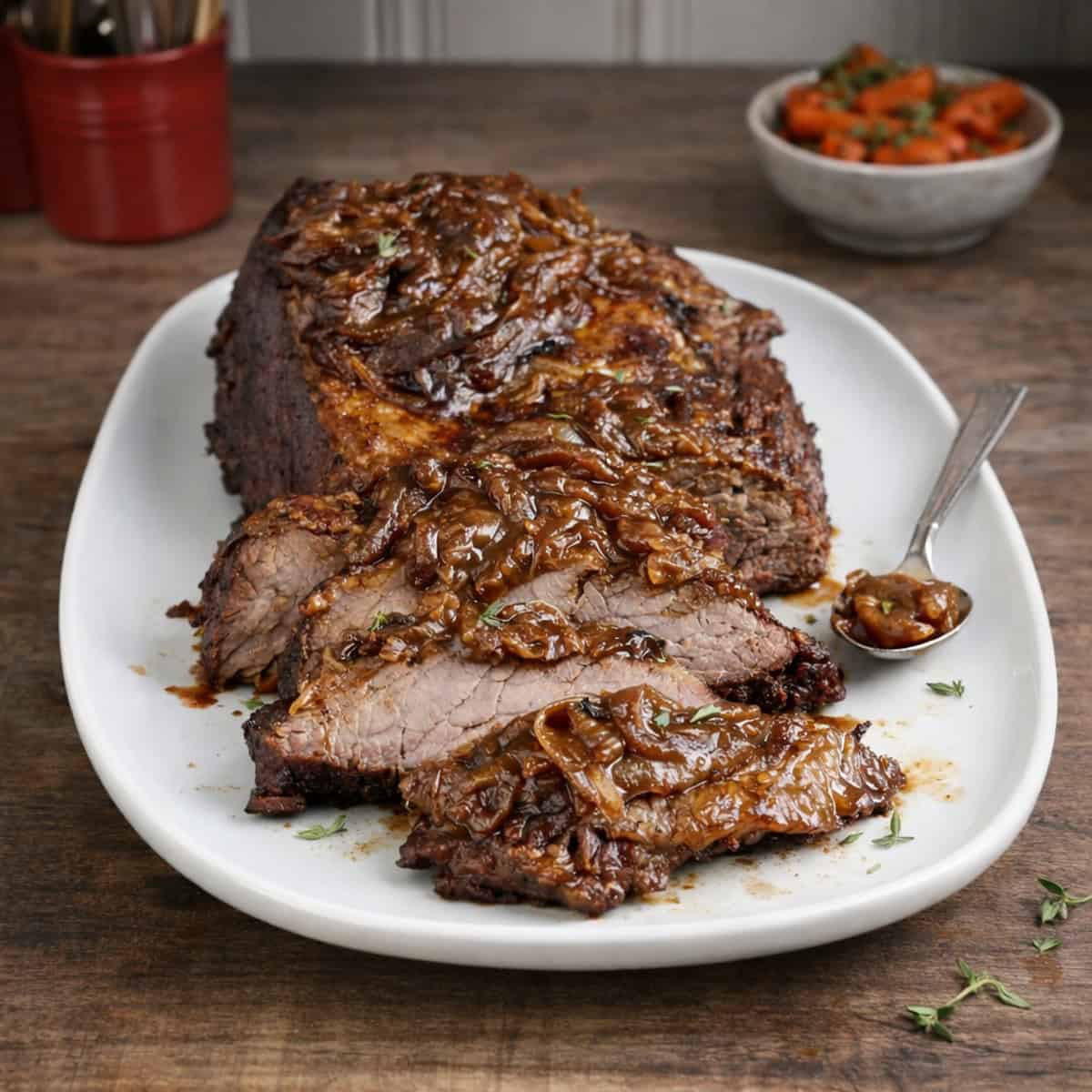
Set the Oven Low. Let It Do Its Job.
Brisket isn’t difficult.
It’s just not interested in being rushed.
You take a cut that’s built to work all day—dense, tight, full of connective tissue—and you give it exactly what it needs: low heat, time, and a little respect.
At Passover, this is the dish that sits quietly in the background, doing its work while everything else happens. No last-minute panic. No juggling. Just a pot in the oven, slowly turning into something that actually matters.
You smell it before you check it.
Onions softening. Beef deepening.
Nothing aggressive. Just steady.
That’s how brisket should cook.
And Yes—There’s the Other Way
If you grew up around this dish, you’ve seen it done differently.
A packet of onion soup mix.
A bottle of Coke.
Everything poured over the brisket and sent into the oven.
And to be fair—it works.
It gives you:
- sweetness
- salt
- tenderness
- a sauce that comes together without much thought
It’s reliable. It’s familiar. It shows up on a lot of holiday tables for a reason.
But it’s also doing all the work for you.
The packet brings the flavor.
The soda brings the sugar and acid.
And somewhere in there, the brisket softens enough to pass.
Nothing wrong with that.
But it’s not the same thing.
The Long Game
This version asks more of you.
You build the flavor yourself.
You take the time to brown the meat properly.
You let the onions collapse and become the sauce instead of relying on a packet to do it for you.
You control the liquid instead of pouring it from a bottle.
At 200°F, nothing is forced.
The heat stays gentle.
The liquid stays quiet.
The meat changes slowly—exactly the way it’s supposed to.
Over time:
- the collagen melts
- the onions dissolve into the braise
- the carrots soften but hold
- the entire dish becomes balanced instead of just sweet
You don’t get that from shortcuts.
Why It’s Worth It
Because the difference shows up in every bite.
The sauce tastes like beef and onions, not seasoning mix.
The sweetness is natural, not pushed.
The texture holds together without falling apart.
And maybe more importantly—
you know exactly how it got there.
That’s the shift.
From: something that works
To: something you actually understand
Ingredient Intelligence
The brisket is the reason you’re here, but it doesn’t carry itself.
Onions do the heavy lifting. They start sharp and end soft, almost sweet, turning into the body of the sauce without you forcing it.
Carrots keep things honest. A little sweetness, a little structure, something to push back against the richness.
Garlic stays in the background. If you taste garlic first, you did too much.
A touch of tomato paste or wine—if you use them—should disappear into the dish, not announce themselves.
And the liquid? Stock, water — it doesn’t matter as much as people think. What matters is how you built everything before it went in.
Technique Itelligence
You don’t start in the oven. You earn the oven.
The pot goes on the stove and gets properly hot. The brisket goes in and stays there until it takes on real color. Not rushed. Not pale. This is where the dish begins.
Once it’s out, the onions go in—more than you think you need. They soften, release moisture, and slowly become the base of everything.
Garlic follows briefly.
Then the liquid—just enough to come partway up the meat. Not covering. Not drowning.
Carrots go in last.
Then into the oven.
200°F. Covered. Leave it alone. (Approx 6-8hrs)
What 200°F Actually Means
At higher heat, brisket tightens before it breaks down.
At 200°F, it relaxes.
The heat stays even.
The liquid barely moves.
The structure changes without collapsing.
It doesn’t look dramatic while it’s happening.
That’s how you know it’s working.
When It’s Ready
Not when the timer says so. When a knife slides in and meets just enough resistance—then gives. When the meat holds together but doesn’t fight you. When the onions are no longer onions. That’s when you pull it. And then you let it rest.
On the Platter
Slice it against the grain. The slices should hold, but barely. Spoon the onions, carrots, and sauce over the top or offer in a seperte bowl.
Nothing forced. Nothing styled. Just food that’s been treated properly from the start.
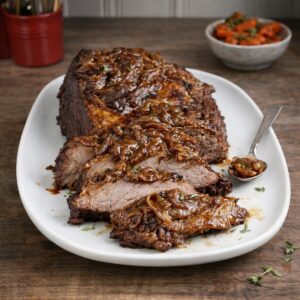
Braised Beef Brisket with Onions and Carrots

Equipment
- Tongs
- Chef’s knife
- Measuring cups and spoons
- Aluminum foil if needed for a tighter cover
Ingredients
- 1 beef brisket about 4 to 5 pounds
- 2 tablespoons neutral oil
- Kosher salt to season generously
- 1 teaspoon black pepper
- 3 large onions halved and sliced
- 4 large carrots peeled and cut into thick pieces
- 4 garlic cloves smashed
- 2 tablespoons tomato paste
- 1 cup dry red wine or 1 cup water
- 2 cups beef stock
- 2 bay leaves
- 1 teaspoon dried thyme or 2 sprigs fresh thyme
Instructions
Prepare the brisket
- Heat the oven to 200°F.
- Pat 1 beef brisket (4 to 5 pounds) dry with paper towels.
- Season the brisket generously on both sides with kosher salt and 1 teaspoon black pepper.
Sear the meat
- Heat 2 tablespoons neutral oil in a large Dutch oven over medium-high heat.
- Add the brisket and sear until deeply browned, about 5 to 7 minutes per side.
- Remove the brisket and set aside.
Build the braise
- Lower the heat to medium.
- Add 3 sliced onions to the pot and cook, stirring occasionally, until softened and beginning to collapse, about 10 to 12 minutes.
- Add 4 smashed garlic cloves and 2 tablespoons tomato paste and cook for 1 to 2 minutes, stirring to coat the onions.
- Pour in 1 cup dry red wine or 1 cup beef stock, scraping up any browned bits from the bottom of the pot.
- Add 2 cups beef stock, 2 bay leaves, and 1 teaspoon dried thyme or 2 sprigs fresh thyme.
- Add the carrots and braise
Return the brisket to the pot, fat side up.
- Add 4 large carrots, cut into thick pieces, around the brisket.
- The liquid should come about one-third to halfway up the meat. Add a little more stock if needed, but do not submerge the brisket.
- Cover tightly with the lid, or with foil and then the lid for a tighter seal.
- Transfer to the 200°F oven and braise for 6 to 8 hours, until a knife slides in with light resistance and the meat is tender but still holds together.
Rest and slice
- Remove the brisket from the oven and let it rest in the braising liquid for 20 to 30 minutes.
- Transfer the brisket to a cutting board.
- Slice against the grain into even slices.
Finish and serve
- Remove the bay leaves and thyme stems if using fresh thyme.
- Spoon the softened onions, carrots, and braising liquid over the sliced brisket.
- Taste the sauce and adjust seasoning with kosher salt if needed.
- Serve warm.
Notes
A 200°F oven braise gives the brisket time to break down slowly without tightening up.
Slice against the grain or the brisket will chew tough no matter how well it’s cooked.
This dish is often even better the next day after the flavors settle.
Storage
Refrigerate leftovers in the braising liquid for up to 4 days.
Comments
No Comments