
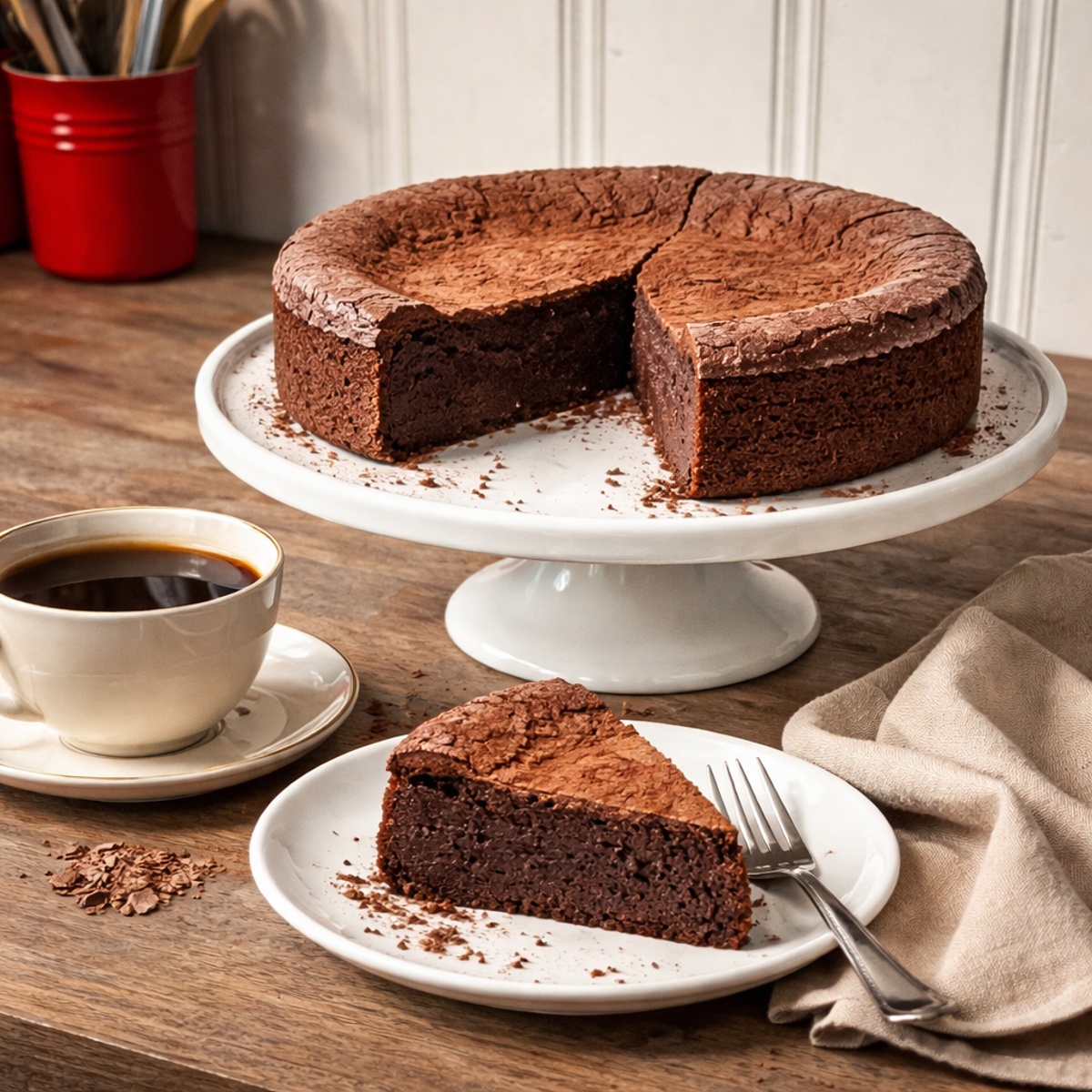
Deep, Clean Chocolate — Structure Without Flour
Flourless chocolate cake has been misunderstood for years—turned into something dense, overly rich, and frankly a little exhausting to eat. It shows up at the end of a meal like a statement piece, when what you actually want is something that finishes clean. But when it’s done right—when the chocolate is chosen carefully, the eggs are handled with restraint, and the timing isn’t pushed—it becomes something else entirely. It rises with confidence in the oven, then settles back into itself as it cools, leaving behind a cake that feels light without losing its depth, structured without feeling heavy, and rich in a way that invites another bite instead of shutting you down.
Technique Intelligence
This cake is built on air, not flour.
That’s the first thing to understand, because everything that follows depends on it.
Without flour, there’s nothing to absorb or stabilize in the traditional sense. The structure comes from eggs—how they’re handled, how much air they hold, and how gently that air is carried through the batter. The chocolate supports that structure, but it doesn’t create it.
When the egg whites are whipped, they expand, trapping air and building the lift that allows the cake to rise in the oven. But that lift is temporary. It’s meant to be. The structure sets just enough to hold, then relaxes as it cools, settling back into itself.
That collapse isn’t a flaw—it’s the point.
The mistake is trying to bake it until it feels finished in the oven. If you wait for that, you’ve gone too far. The proteins in the eggs tighten, the moisture is pushed out, and what should be soft and controlled becomes dense and dry.
Instead, you’re baking just to the edge of structure.
The sides should be set. The center should still have movement. When it comes out, it will look slightly underdone—that’s exactly where it needs to be. The carryover heat finishes the work, not the oven.
And then it falls.
What’s left behind is the texture you’re after—light, structured at the edge, and soft through the center, somewhere between a cake and a soufflé, but fully its own.
That only happens if you respect the air you built at the beginning and resist the instinct to overbake it at the end.
Ingredient Intelligence
There are very few ingredients here, which means each one carries more weight than it would in a traditional cake.
Chocolate
Chocolate is the foundation, and it determines everything that follows.
This isn’t the place for generic baking chocolate or anything overly sweet. What you choose here defines not only the flavor, but the structure and the way the cake finishes on the palate. A chocolate that’s too low in cocoa content brings excess sugar, which flattens the flavor and pushes the cake toward something one-dimensional. Too high, and the bitterness becomes dominant, drying the finish and making the cake feel more rigid than it should.
The balance sits in that middle range—bittersweet chocolate with enough cocoa content to give depth, but enough sugar to keep the edges rounded. When it melts, it should feel smooth and fluid, not thick or resistant. That fluidity is what allows it to integrate with the eggs and create a structure that holds without becoming heavy.
Form matters as much as percentage. Chocolate bars, chopped by hand, melt more cleanly and predictably than chips, which are designed to hold their shape and often resist smooth melting. That difference shows up immediately in texture. A clean melt gives you a clean set. A compromised melt gives you a dull, slightly tight interior that never quite comes together.
Even the way it’s melted changes the outcome. Chocolate should be brought to temperature gently, just until it loosens and becomes workable. Push it too far, and it begins to seize and tighten before it ever reaches the batter. That tension carries through the entire cake.
Handled correctly, the chocolate becomes the structure, the flavor, and the finish all at once—deep, balanced, and clean.
Eggs
Eggs do the rest of the work.
They bind everything together while providing just enough lift to keep the cake from collapsing into density. But they’re sensitive to how they’re handled. Overmixed, they lose their ability to hold air. Overbaked, they tighten and pull the structure inward.
They need to be incorporated with control, not force. When handled properly, they create a structure that feels light without ever being airy in the traditional sense.
Butter
Butter does more than add richness—it changes how the cake finishes.
In a flourless cake, where structure comes almost entirely from chocolate and eggs, the butter plays a quieter but critical role. It softens the edges of the chocolate, rounding out any sharpness and giving the cake that smooth, almost melt-away quality as it warms on the palate. But not all butter behaves the same.
A higher-fat butter brings a cleaner, more cohesive texture. With less water and more fat, it integrates more easily into the chocolate, helping the mixture stay smooth and unified instead of separating or tightening. That difference shows up in the final slice—subtle, but unmistakable.
Temperature matters just as much as quality. Butter should meet the chocolate while both are warm enough to combine without resistance. Too cool, and it won’t fully incorporate. Too hot, and the mixture can break, leaving the cake slightly greasy or uneven.
Used properly, it doesn’t stand out. It supports the chocolate, softens the structure, and lets the cake finish clean instead of heavy.
Sugar
Sugar brings balance and stability.
It tempers the bitterness of the chocolate and helps retain moisture, but it’s easy to overdo. Too much sugar dulls the flavor and turns the cake into something predictable. Too little, and the chocolate feels harsh and unfinished.
The goal isn’t sweetness—it’s control.
Equipment
- Mixing bowls
- Heatproof bowl
- Saucepan (for double boiler)
- Whisk or spatula
- 8-inch cake pan or springform
- Parchment paper
Storage & Serving
The cake holds well, but it changes depending on temperature.
At room temperature, it’s soft and open. In the refrigerator, it firms slightly, becoming more structured and dense. Neither is wrong—it just depends on how you want it to eat.
Serve it slightly cool or just under room temperature, where it holds cleanly but still softens as you cut into it.
Serving Notes
Keep it restrained.
A light dusting of cocoa or sugar is enough. This isn’t a cake that needs decoration or distraction. The focus should stay on the texture and the chocolate itself.
Small slices work best. It should feel like a finish, not a second course.
FAQ
Why is my cake too dense?
It was likely overbaked or the eggs were overworked, tightening the structure.
Why is it dry?
Too much heat or too long in the oven.
Can I make it ahead?
Yes. It actually improves slightly as it sets.
Should it be fudgy or firm?
Neither. It should be structured but soft.
Chocolate Decadence (Flourless Fallen Soufflé Cake)

Equipment
- Heatproof mixing bowl
- Saucepan (double boiler setup)
- Stand mixer or hand mixer
- Rubber spatula
- 9-inch springform pan (preferred for height)
Ingredients
- 10 ounces bittersweet chocolate 65–70%, chopped
- 10 tablespoons unsalted high-fat butter
- ¾ cup granulated sugar
- 12 large eggs separated
- 1 teaspoon vanilla extract
- ½ teaspoon kosher salt
- Cocoa powder for finishing
Instructions
- Preheat oven to 325°F.
- Line a 9-inch springform pan with parchment and lightly butter.
In a heatproof bowl over gently simmering water, melt:
- 10 oz bittersweet chocolate
- 10 tablespoon butter
- Stir until smooth. Remove from heat and cool slightly.
In a bowl, whisk together:
- 12 egg yolks
- ¾ cup sugar
- 1 teaspoon vanilla
- ½ teaspoon kosher salt
Whisk until slightly thickened and smooth.
- Slowly incorporate the warm chocolate mixture into the yolk mixture, stirring gently until fully combined.
In a stand mixer, whip 12 egg whites to soft-medium peaks.
- Not stiff—structure comes from controlled air, not rigidity.
Fold the whipped egg whites into the chocolate mixture in 3 additions, using a spatula.
- Fold gently. Maintain as much air as possible without leaving streaks.
- Pour batter into prepared pan and smooth lightly.
Bake for 35–40 minutes, until:
- edges are set
- center is puffed but still soft
- Remove from oven and cool completely in the pan.
- The cake will rise significantly and collapse as it cools.
- This is intentional and defines the final texture.
Notes
Use high-quality 65–70% chocolate (bar form) for proper structure and flavor.
Avoid chocolate chips—they interfere with melting and texture.
Use unsalted high-fat butter for better emulsification and a smoother finish.
Egg whites should be soft-medium peaks, not stiff—overwhipped whites create a dry collapse.
The cake is not meant to fully set in the center—it should remain soft and tender.
Comments
No Comments