
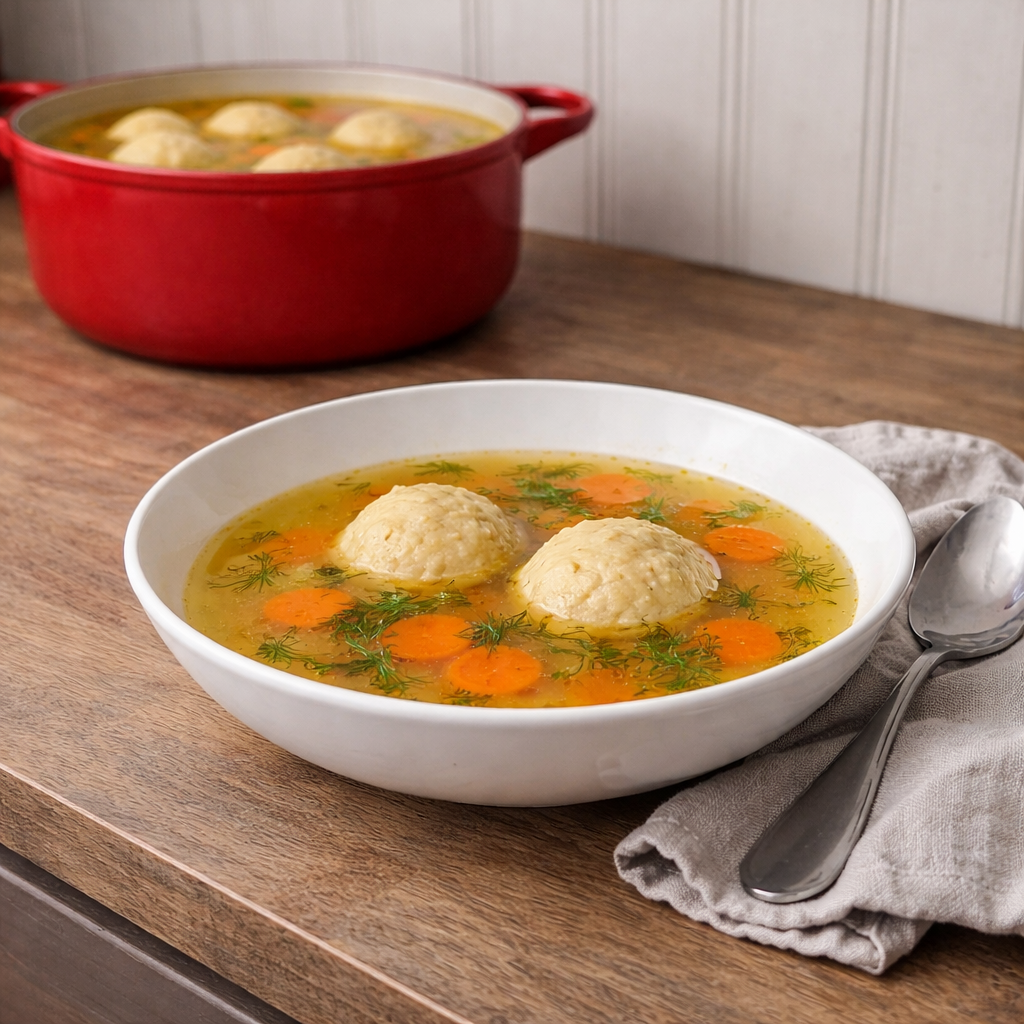
The Passover Bowl That Tells You Exactly What Kind of Cook You Are
Matzo ball soup looks simple right up until it isn’t. A pot of golden broth, a dumpling, a few vegetables, maybe a little dill. Harmless enough. But this bowl has zero patience for sloppy cooking. Rush the stock and it turns flat and cloudy. Mishandle the matzo mixture and you get dumplings like wet cement or dumplings that collapse like bad promises.
That’s the point.
Matzo ball soup is one of those dishes that strips cooking back to the bones: extraction, seasoning, texture, restraint. No sear to hide behind. No crust. No glaze. No drama. Just whether you know how to build flavor in water and structure in starch.
For Passover, that matters. This is not a decorative first course. It is the bowl that settles the table, opens the meal, and tells everyone whether the kitchen knows what it’s doing.
Why You Should Make It
Because this is one of the clearest examples of how technique creates comfort.
Matzo ball soup teaches control better than a dozen louder recipes ever could. You learn how to coax a clean broth instead of bullying one into existence. You learn how eggs, fat, and matzo meal behave when they’re balanced properly. You learn that dumplings are not about force. They are about handling just enough and then backing off.
And unlike a lot of “holiday classics,” this one earns its place. A good matzo ball soup feels generous without being heavy, comforting without being dull, and traditional without needing to be museum food. It still tastes alive when it’s made with care.
Technique Intelligence
Start with a broth that tastes like it had a purpose
This is not the time for boxed stock with a prayer and some floating parsley. Matzo ball soup depends on a broth with body and clarity. That means chicken with bones, cold water to start, and a slow rise to a gentle simmer. Not a boil. A boil is for people in a hurry and soup that tastes like punishment.
The goal is extraction without violence. You want collagen for body, rendered fat for flavor, and aromatics that taste like they belong in the pot rather than like they were screamed into it.
A proper chicken broth for matzo ball soup should be golden, clean, and deeply savory. Not muddy. Not greasy. Not flat.
Matzo balls are built, not guessed
Matzo balls live or die on proportion and patience. Eggs bind. Matzo meal absorbs. Schmaltz or oil tenderizes. Liquid loosens. Resting time gives the mixture a chance to hydrate and settle into itself.
That rest matters more than people think. Skip it and the mixture won’t behave. Overwork it and the dumplings tighten up. Shape them too aggressively and you compress the life out of them before they ever hit the pot.
The trick is simple: mix thoroughly, rest completely, shape lightly.
Simmer is your friend. Boiling is a thug.
Once the matzo balls go into the pot, your job is to leave them alone and maintain a steady gentle simmer. A rolling boil batters them, clouds the cooking liquid, and wrecks the texture. Good matzo balls need calm heat so they can expand, set, and stay tender.
This is not flashy cooking. It’s disciplined cooking. Which is usually where the good stuff lives.
Ingredient Intelligence
Chicken
The chicken is not just there to make broth. It is the engine of the entire dish. Bone-in pieces bring depth, collagen, and fat, which means the broth tastes like a real soup instead of hot salted water. Wings, backs, thighs, and a whole bird all do useful work here. Lean boneless meat does not. It contributes almost nothing except disappointment.
Onion
An onion in this pot is doing more than sweetness. It rounds off the broth, adds depth, and gives the stock that quiet background note you only miss when it’s absent. If the skin goes in, you get extra color. That’s old-school, practical, and effective.
Carrot
Carrot brings sweetness, yes, but more importantly it softens the sharper edges of the broth. In matzo ball soup, carrot is not garnish pretending to be important. It’s part of the broth’s balance. Cut it too small and it disappears into the pot. Cut it properly and it earns its keep.
Celery
Celery is the structural steel of soup aromatics. It doesn’t shout. It supports. It adds that green, savory backbone that keeps chicken broth from drifting into sweetness. Skip it and the soup loses shape.
Dill
Dill is the lift. It is the bright green note that keeps the bowl from feeling brown and sleepy. Long simmered dill gets tired fast, so it belongs near the end, where it can keep its edge and perfume the broth properly.
Matzo Meal
Matzo meal is not flour, and if you treat it like flour you’ll get punished. It absorbs liquid differently, thickens differently, and carries a distinct toasted wheat character that defines the dumplings. This is the ingredient that gives matzo balls their identity, not just their structure.
Eggs
Eggs are the framework. They bind the mixture, help the dumplings set, and give the interior its texture. Too few and the mixture gets unstable. Too many and things start to tip toward softness without structure. In other words: eggs are not filler here. They are engineering.
Schmaltz (rendered chicken fat)
This is where the flavor lives. Schmaltz gives matzo balls richness, tenderness, and that unmistakable old-world depth that neutral oil simply cannot fake. Oil will work if it has to. Schmaltz is what makes them worth remembering. Better Than Bouillon Premium Roasted Chicken Base works well.
Black Pepper
Not decoration. Black pepper matters in matzo ball soup because the dish is otherwise so direct. A little heat sharpens the dumpling mixture and keeps the broth from reading one-note.
Salt
Soup without enough salt is just hot regret. Salt doesn’t just season the broth; it wakes up the chicken, sharpens the vegetables, and gives the dumplings a fighting chance. Underseason matzo ball soup and the whole bowl tastes tired.
Equipment
You will need the right basics:
- Large heavy-bottomed stockpot or Dutch oven
- Fine-mesh strainer
- Mixing bowl for the matzo ball mixture
- Whisk or fork
- Small scoop or spoon for portioning
- Medium pot for cooking matzo balls if cooking separately
- Ladle
- Sharp knife and cutting board
A note worth making: a fine-mesh strainer is not optional if you want a clean broth.
What Makes a Great Bowl
A great matzo ball soup should look calm and confident. The broth should be clear and golden. The matzo balls should be tender, structured, and light enough to feel inviting rather than punishing. The vegetables should taste like they belong there. The dill should smell fresh. Nothing should feel heavy-handed.
Serving Notes
Serve it hot, in warmed bowls, with the matzo balls fully heated through and the broth tasting seasoned from the first spoonful to the last. A little fresh dill on top is enough. This is not the place for garnish gymnastics.
If you’re serving a full Passover meal, this bowl should feel like an opening statement: precise, comforting, and entirely under control.
Matzo Ball Soup (Chicken Soup with Matzo Dumplings)

Equipment
- Large heavy-bottomed stockpot or Dutch oven
- Fine-mesh strainer
- Mixing bowl
- Whisk or fork
- Small scoop or spoon
- Medium pot (for matzo balls)
Ingredients
For the Chicken Broth
- 1 whole chicken 3–4 lbs or 3 lbs bone-in parts (backs, wings, legs)
- 1 large onion halved (skin on)
- 3 carrots cut into large pieces
- 3 celery stalks cut into large pieces
- 4 garlic cloves
- 1 bay leaf
- 1 teaspoon black peppercorns
- Kosher salt to taste
- Fresh dill for finishing
For the Matzo Balls
- 1 cup matzo meal
- 4 large eggs
- 4 tablespoon schmaltz or neutral oil
- ¼ cup chicken stock or water
- 1 teaspoon kosher salt
- ½ teaspoon black pepper
Instructions
Instructions
Build the Broth
- In a large pot, combine 1 whole chicken (3–4 lbs) or 3 lbs bone-in parts, 1 halved onion (skin on), 3 carrots, 3 celery stalks, 4 garlic cloves, 1 bay leaf, and 1 teaspoon black peppercorns.
- Cover with cold water by 2–3 inches and bring slowly to a gentle simmer over medium heat.
- Skim any foam from the surface.
- Maintain a low simmer (do not boil) for 2–2½ hours.
- Remove chicken and strain the broth through a fine-mesh strainer.
- Season with kosher salt to taste.
Prepare the Matzo Ball Mixture
- In a bowl, whisk together 4 large eggs and 4 tablespoon schmaltz (or neutral oil).
- Add ¼ cup chicken stock or water and mix to combine.
- Fold in 1 cup matzo meal, 1 teaspoon kosher salt, and ½ teaspoon black pepper.
- Cover and refrigerate for 30 minutes.
Form the Matzo Balls
- Wet hands lightly.
- Gently roll mixture into balls about 1 to 1½ inches in diameter.
- Do not compress — keep them light.
Finish the Soup
- Bring the strained broth back to a simmer.
- Add the refrigerated matzo balls to the simmering broth.
- Add sliced carrots and cook until tender.
- Cover and cook for 30–40 minutes, without removing the lid.
- Return shredded chicken if desired.
- Finish with fresh dill and adjust seasoning with salt as needed.
Notes
For lighter matzo balls, avoid overmixing and do not compact when shaping.
Schmaltz provides the best flavor; oil can be substituted.
Cooking matzo balls separately helps keep the broth clear.
Storage
Store broth and matzo balls separately for best texture.
Refrigerate up to 3 days.
Reheat gently — do not boil.

Comments
No Comments