
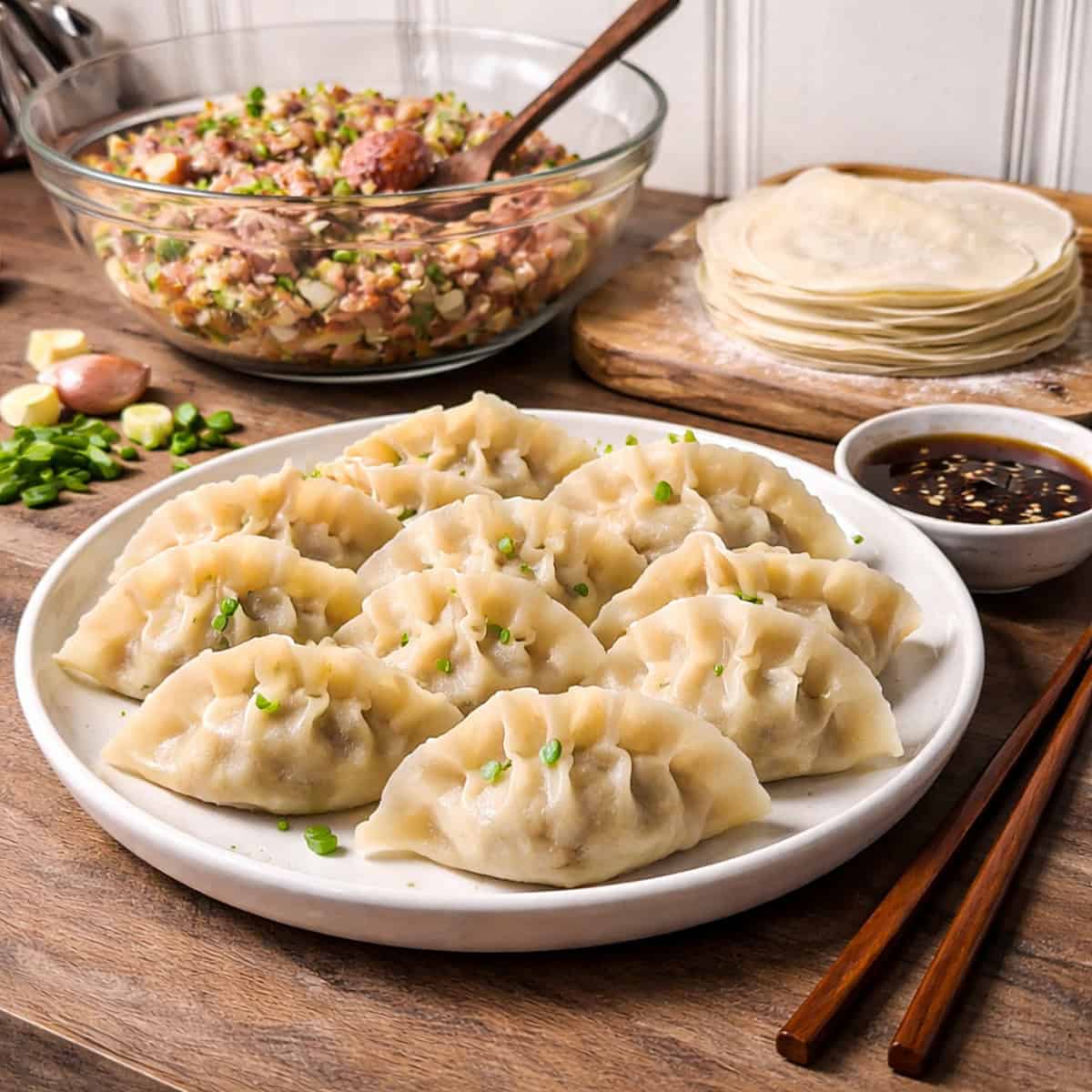
Jiaozi are not party food. They’re not appetizers. They’re dinner — the kind of dinner that involves a table, a rhythm, and usually more hands than one.
In northern China, jiaozi show up for holidays, sure, but they’re just as likely to appear on an ordinary night, steam fogging the windows, flour on the table, conversation rolling along with the dough. They’re practical food made carefully, not delicately.
Good jiaozi are juicy, balanced, and comforting. Great ones are quietly precise.
What Jiaozi Are Really About
Jiaozi aren’t about fancy pleats or novelty fillings.
They’re about balance and containment.
You’re managing:
- A wrapper that stretches without tearing
- A filling that stays juicy but not wet
- Seasoning that’s present without shouting
- A seal that survives boiling
If any one of those fails, the dumpling fails.
Wrapper Intelligence(面皮逻辑)
Jiaozi wrappers are simple by design — flour, water, pressure, rest.
They should be:
- Thicker in the center
- Thinner at the edges
- Soft enough to seal
- Strong enough to boil
Uniform, store-bought wrappers are convenient, but handmade wrappers give you control where it matters most: thickness and stretch. That control is what keeps the filling inside the dumpling, not floating loose in the pot.
Filling Intelligence(馅料思路)
Pork
Traditional jiaozi fillings rely on pork for a reason. It carries flavor and fat evenly. Lean meat dries out. Too much fat overwhelms. The sweet spot matters.
Napa Cabbage or Chives
Vegetables bring moisture and freshness, but they must be managed. Salt draws out excess water, which should be squeezed away before mixing. Watery filling bursts wrappers and dilutes flavor.
Ginger & Scallion
These are structural aromatics. Ginger cuts richness and warmth; scallions lift everything else. Neither should dominate.
Soy Sauce & Sesame Oil
Soy sauce provides salt and depth; sesame oil finishes the aroma. Sesame oil should be present but restrained — it perfumes the filling, it doesn’t announce itself.
Stock or Water
A spoonful mixed into the filling makes the dumplings juicy from the inside out. This is one of the quiet differences between good dumplings and memorable ones.
Technique Intelligence: Mixing and Folding Jiaozi
(技术关键)
Jiaozi filling is mixed in one direction. This isn’t superstition — it develops structure so the filling holds together and stays juicy instead of crumbly.
Wrappers are filled modestly. Overfilling leads to tearing; underfilling leads to blandness. The seal matters more than the pleat. A simple crescent that holds is always better than an ornate dumpling that leaks.
Boiled jiaozi should float when they’re ready, but timing matters more than float alone. The wrapper should be tender, not bloated, and the filling fully cooked but still juicy.
Wine Pairing
Jiaozi are savory, aromatic, and meant to be eaten in succession, not analyzed one by one. The wine should refresh the palate and stay flexible across fillings and dipping sauces.
A dry Riesling is the safest and most versatile choice. Its acidity cuts through pork fat, balances soy and vinegar, and doesn’t interfere with ginger or scallion. Keep it lean rather than sweet.
Sparkling wine works especially well here. A Brut sparkling or dry Prosecco lifts the richness and keeps the meal moving, particularly when dumplings are pan-fried or served in quantity.
If you prefer red, keep it light and low-tannin. Gamay or a lightly chilled Pinot Noir can work with pork or vegetable fillings, especially when the dipping sauce leans savory rather than spicy.
Avoid heavily oaked wines or anything high in alcohol. Dumplings reward rhythm and repetition—the wine should help you keep pace.
Jiaozi Dumplings(饺子)

Ingredients
Ingredients
Homemade Dumpling Wrappers
- 3 cups all-purpose flour about 360 g
- ¾ to 1 cup hot water 180–240 ml, as needed
- Extra flour for dusting
- Or use 40–45 store-bought round jiaozi wrappers
Filling
- 1 lb ground pork 70–80% lean
- 2 cups napa cabbage finely chopped
- 1 teaspoon salt for salting cabbage
- 2 scallions finely sliced
- 1 tablespoon fresh ginger grated
- 2 tablespoons light soy sauce
- 1 tablespoon Shaoxing wine or dry sherry
- 1 teaspoon sesame oil
- 3 tablespoons water or stock
For Cooking
- Water for boiling
Instructions
Instructions
Make the Dumpling Wrappers
- Place flour in a bowl. Gradually add hot water, stirring with chopsticks or a fork until shaggy.
- Knead until a smooth, firm dough forms, about 8–10 minutes.
- Cover and rest at room temperature for 30 minutes.
- Divide dough into 4 pieces. Roll each into a rope and cut into small pieces (about 10 g each).
- Flatten each piece and roll into a thin circle, thicker in the center and thinner at the edges.
- Keep wrappers covered while working to prevent drying.
Make the Filling
- Toss chopped cabbage with salt and let sit for 10 minutes. Squeeze out excess moisture.
- In a bowl, combine pork, cabbage, scallions, ginger, soy sauce, Shaoxing wine, sesame oil, and water or stock.
- Mix in one direction until cohesive and slightly sticky.
Assemble and Cook
- Place a small spoonful of filling in the center of each wrapper.
- Lightly moisten the edge, fold into a half-moon, and seal firmly.
- Bring a large pot of water to a rolling boil.
- Add dumplings and stir gently to prevent sticking.
- When dumplings float, cook for 2–3 minutes more until wrappers are tender and filling is cooked through.
- Remove with a slotted spoon and serve hot.
Notes
Common Misunderstandings(常见误解)
- “More filling is better.”
It isn’t. Balance beats volume. - “Fancy pleats mean better dumplings.”
They don’t. A tight seal matters more. - “All dumplings are the same.”
They aren’t. Jiaozi are built for boiling — different rules apply.
How Jiaozi Are Traditionally Served
(食用方式)
Jiaozi are served hot, straight from the pot, often piled into a bowl or plate meant for sharing.
Classic Pairings
- Black vinegar(陈醋)
- Soy sauce
- Chili oil (optional, not mandatory)
- Garlic (sparingly)
The dumpling should carry the meal. The sauce is there to sharpen, not drown.
Storage & Make-Ahead Notes
Jiaozi are designed for freezing. Properly sealed dumplings freeze beautifully and cook straight from frozen without thawing.
Fresh dumplings should be cooked the same day. Refrigeration dulls the wrapper and weakens the seal.
Comments
No Comments