
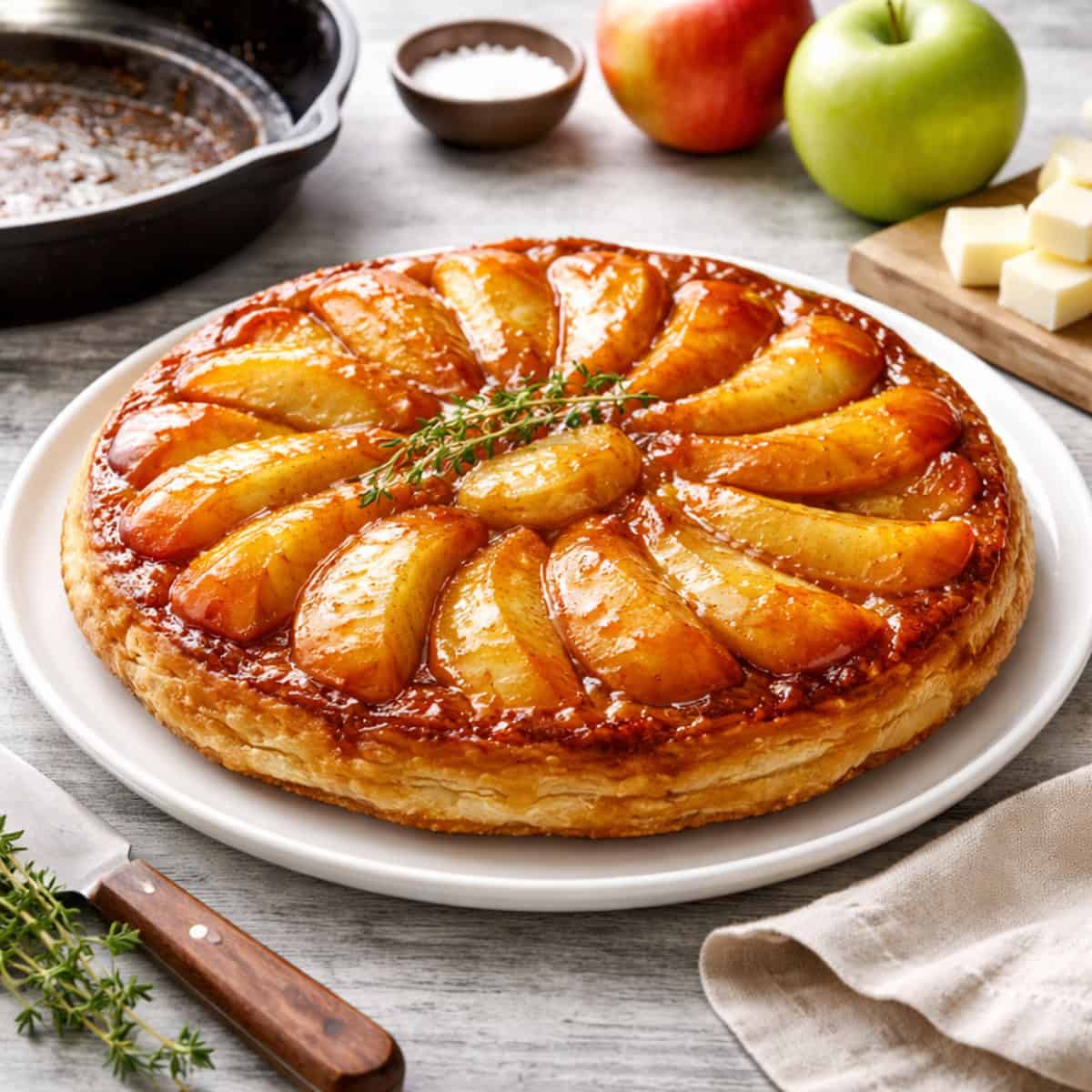
Apple Tatin is what happens when butter, sugar, and gravity collaborate. You cook apples directly in caramel. You trap them beneath pastry. Then you invert the entire thing while it’s still dangerously hot. If your timing is right, the apples gleam like amber glass. If your timing is off, it’s still delicious — just humbling.
Why This Dish Matters
Tarte Tatin teaches caramel control, moisture management, and heat discipline.
You learn:
- How sugar transforms under rising heat
- How fruit structure affects final texture
- How steam impacts pastry crispness
- Why timing matters more than courage
Once you understand this tart, you understand caramel.
Technique Intelligence
Caramel Control
We’re using a dry caramel — sugar alone in the pan. No water. No safety net.
Sugar melts around 320°F.
It caramelizes between 340–350°F.
Above 355°F, bitterness arrives quickly.
Watch the color, not the clock. You want deep amber, not dark brown. It should smell warm and nutty. Sharp or acrid means you’ve gone too far.
When you add butter, it will bubble aggressively. That reaction is normal — you’re emulsifying fat into molten sugar. Keep stirring gently until smooth.
Apple Structure
Firm apples are non-negotiable. You need pectin and cell structure strong enough to soften without collapsing.
High-acid apples balance the caramel’s sweetness and prevent the tart from tasting flat.
Pre-Cooking the Apples
Cooking the apples in the caramel before baking accomplishes two critical things:
- Begins tenderizing the fruit.
- Evaporates excess surface moisture.
If you skip this, the pastry steams instead of crisps. Steam is the enemy of flaky layers.
The Flip
Timing determines success.
Let the tart rest 3–5 minutes after baking.
Too soon and caramel floods.
Too late and it hardens in place.
Place a serving plate firmly over the skillet. Flip in one decisive motion. Hesitation is more dangerous than confidence.
Ingredient Intelligence
Apples – Structure and acidity matter more than sweetness.
Granulated sugar – Pure sucrose caramelizes cleanly and predictably.
Unsalted butter – Emulsifies and enriches the caramel.
Puff pastry – Reliable and crisp when baked hot.
Sea salt – Prevents the caramel from tasting one-dimensional.
Optional thyme or vanilla – A subtle aromatic lift without overpowering the fruit.
Suggested Apple Varieties
Not all apples behave under heat. Choose wisely.
Best Overall (structure + balance):
Granny Smith – High acid, firm flesh, classic choice.
Honeycrisp – Holds shape beautifully with balanced sweetness.
Braeburn – Excellent structure with subtle spice notes.
Slightly Sweeter but Reliable:
Pink Lady (Cripps Pink) – Bright acidity with firmness.
Jonagold – Stable if not overcooked.
Traditional French Option:
Reine des Reinettes – Classic French baking apple when available.
Avoid:
McIntosh, Cortland, Red Delicious.
They collapse quickly and release too much moisture.
Professional move: Use a blend. Half Granny Smith for structure, half Honeycrisp or Pink Lady for aroma and balance.
Equipment That Matters
- 10-inch oven-safe cast iron skillet
- Heatproof spatula
- Sharp paring knife
- Cooling rack
- Thick towel for handling the pan during inversion
The skillet is not optional. It is the vessel and the mold. If it cannot go from stovetop to oven seamlessly, the structure fails.
Wine Pairing
Late-harvest Riesling brings acidity and honeyed notes that echo the caramel.
For something more traditional: a small pour of Calvados alongside the tart.
Apple Tarte Tatin

Equipment
- Equipment
- 10-inch oven-safe cast iron skillet
- Heatproof spatula
- Paring knife
- Rolling Pin
- Cooling rack
- Thick kitchen towel
Ingredients
Ingredients
- 6 –7 medium firm apples Granny Smith, Honeycrisp, Braeburn, or Pink Lady, peeled, cored, halved
- 1 cup 200g granulated sugar
- 6 tablespoons 85g unsalted butter, cubed
- ½ teaspoon fine sea salt
- ½ teaspoon vanilla extract optional
- 1 sheet all-butter puff pastry thawed
- 1 teaspoon fresh thyme leaves optional
Instructions
Instructions
- Preheat oven to 400°F (200°C).
Make the dry caramel:
- In a 10-inch oven-safe cast iron skillet over medium heat, sprinkle 1 cup (200g) granulated sugar evenly across the bottom. Do not stir. Allow sugar to melt, swirling the pan occasionally until it turns a deep amber color.
Add butter:
- Carefully add 6 tablespoons (85g) unsalted butter. Stir gently with a heatproof spatula until fully melted and combined. Add ½ teaspoon sea salt and ½ teaspoon vanilla extract (if using).
Arrange apples:
- Place 6–7 halved apples cut-side up in tight concentric circles in the caramel. Cook over medium-low heat for 10–12 minutes, allowing apples to soften slightly and release moisture.
Prepare pastry:
- Roll 1 sheet puff pastry slightly larger than the skillet (about 11 inches). Lay pastry over apples and tuck edges down inside the skillet using a spoon.
Bake:
- Transfer skillet to oven and bake 25–30 minutes until pastry is deeply golden and crisp.
Rest and invert:
- Remove from oven and let rest 3–5 minutes. Place a serving plate over the skillet and flip carefully in one decisive motion. Lift skillet slowly to release tart.
Notes
Refrigerate up to 2 days; rewarm gently at 300°F to soften caramel before serving.

Comments
No Comments