
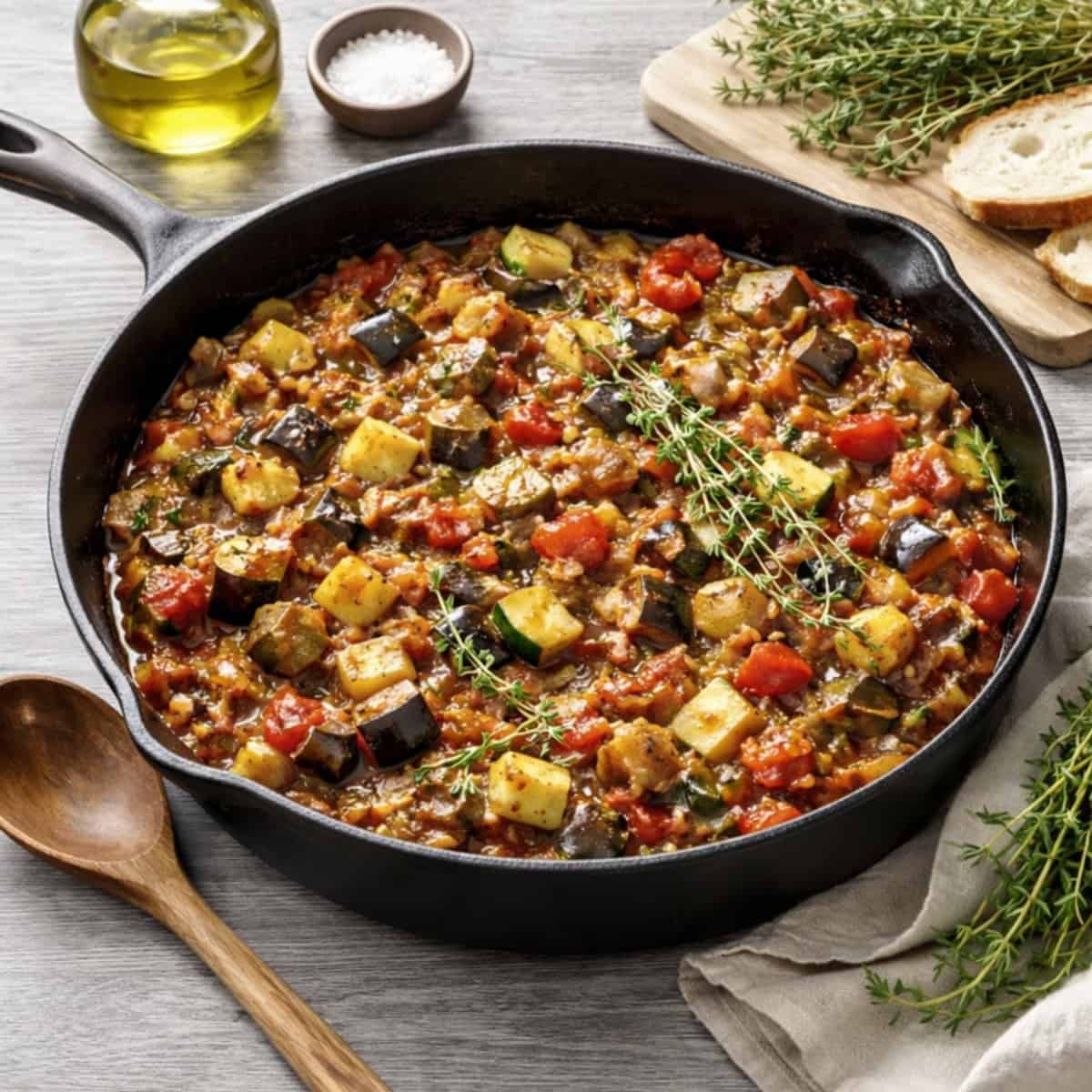
Ratatouille is a Provençal vegetable stew built from eggplant, zucchini, peppers, tomato, garlic, and olive oil. The success of the dish depends on controlled cooking — each vegetable handled separately so the final result is cohesive, glossy, and intact.
Why This Dish Matters
Ratatouille is climate cooking. Southern France grows eggplant, zucchini, peppers, and tomatoes in the same sun and soil. Olive oil binds them. It is economical, seasonal, and regional — not a mixed vegetable casserole, but a methodical expression of place.
Technique Intelligence
Sequential Vegetable Cooking — The Core Principle
Ratatouille fails when vegetables are treated as a single mixture.
Each vegetable behaves differently under heat:
- Eggplant absorbs oil and needs browning to develop flavor.
- Zucchini releases water quickly and collapses if overcooked.
- Peppers require time to soften and sweeten.
- Tomatoes break down and form the sauce base.
If everything goes into the pot at once, moisture accumulates faster than it evaporates. The vegetables steam. The result is watery and gray.
Surface area and evaporation control are the difference between stew and mush.
Salting the Eggplant
Eggplant contains sponge-like cells filled with water and air. Salting draws out excess moisture and firms the structure slightly.
When patted dry and sautéed, salted eggplant browns instead of steams. Browning develops caramelized flavor that anchors the entire dish.
Skipping this step reduces depth.
Browning in Batches
Crowding the pan lowers temperature. When the temperature drops, vegetables release water instead of browning.
You are looking for:
- Light golden edges
- Slight resistance
- Oil shimmering, not pooling
If vegetables look pale and wet, the pan is overcrowded.
Controlled Reduction
Tomatoes introduce acid and liquid. That liquid must reduce slowly.
The lid stays off.
Heat remains moderate.
Stir occasionally, not constantly.
You want gentle evaporation, not boiling.
Final Merge
Once each vegetable is properly cooked, they are reunited for a short final simmer. This allows flavor integration while preserving individual texture.
Ratatouille should be soft but structured — not collapsed into sauce.
Ingredient Intelligence
Eggplant
Provides body and absorbs olive oil. Browning gives depth.
Zucchini
Adds freshness and contrast. Should remain tender but intact.
Bell Peppers
Bring sweetness and color. They balance tomato acidity.
Tomato
Forms the sauce foundation. Fresh ripe tomatoes or high-quality whole canned tomatoes work best.
Onion and Garlic
The aromatic base. They build sweetness and structure under the vegetables.
Olive Oil
Essential to the dish’s identity. Use good-quality olive oil; this is Mediterranean cooking.
Thyme and Bay
Subtle herbal backbone. Herbs de Provence may be used lightly, but restraint matters.
Suggested Equipment
Large, wide sauté pan or Dutch oven (5–6 qt)
Surface area matters more than depth. A wide pan allows moisture to evaporate properly. A narrow pot traps steam and creates watery vegetables.
Colander
Used for salting and draining the eggplant. This step improves browning and prevents excess oil absorption.
Sharp chef’s knife
Uniform vegetable cuts ensure even cooking. Inconsistent sizes lead to uneven texture.
Wooden spoon or silicone spatula
Gentle stirring preserves structure. Aggressive stirring breaks down softened vegetables.
Optional: Sheet pan (if roasting eggplant instead of stovetop browning)
For a slightly lighter version, eggplant can be roasted separately at 400°F until golden, then folded in.rrow pots trap moisture.
What Can Go Wrong
Watery ratatouille
→ Too many vegetables added at once or insufficient reduction.
Mushy zucchini
→ Added too early or cooked too long.
Oily finish
→ Excess oil added during eggplant browning.
Sharp acidity
→ Tomatoes under-reduced.
Flat flavor
→ Insufficient salt or lack of browning in early stages.
Wine Pairing
Flavor logic: medium acidity, herbal profile.
Canonical: Côtes du Rhône (Grenache-based).
Alternative: Provençal Rosé.
Avoid: Heavy oaked Chardonnay or tannic Cabernet.
Table Itinerary
Serve with:
- Grilled lamb chops
- Roast chicken
- Crusty country bread
- Or over soft polenta
Also excellent at room temperature as part of a Provençal table.
Variations & Regional Notes
Traditional Provençal ratatouille is rustic and stovetop-based.
The layered “confit byaldi” version popularized in modern cuisine is a refinement, not the historical preparation.
Some cooks include a small amount of tomato paste for depth, but it is not required.
Storage & Make-Ahead
Refrigerate up to 4 days.
Flavor improves after several hours of rest.
Serve warm or room temperature.
Freezes well up to 2 months.
Ratatouille

Equipment
- Equipment
- Large wide sauté pan or 5–6 qt Dutch oven
- Colander
- Sharp chef’s knife
- Wooden spoon or silicone spatula
- Wide surface area is important for proper evaporation.
Ingredients
Ingredients
- 1 large eggplant cut into 1-inch cubes
- 1 teaspoon kosher salt for salting eggplant
- 4 tablespoons olive oil divided
- 1 medium yellow onion diced
- 3 garlic cloves minced
- 1 red bell pepper diced
- 1 yellow bell pepper diced
- 2 medium zucchini sliced into half-moons
- 3 medium ripe tomatoes chopped
- or 1 14-oz can whole tomatoes, crushed
- 1 teaspoon fresh thyme leaves or ½ teaspoon dried thyme
- 1 bay leaf
- ½ teaspoon freshly ground black pepper
- Additional salt to taste
Instructions
Instructions
- Toss 1 cubed eggplant with 1 teaspoon kosher salt and let sit in a colander for 30 minutes. Pat dry with paper towels.
- Heat 2 tablespoons olive oil in a wide sauté pan over medium-high heat. Brown eggplant in batches until lightly golden, about 6–8 minutes. Remove and reserve.
- Add remaining 2 tablespoons olive oil to the pan. Sauté 1 diced onion for 5 minutes until translucent.
- Add 3 minced garlic cloves and cook 30 seconds.
- Add 1 diced red bell pepper and 1 diced yellow bell pepper and cook 5–6 minutes until softened.
- Stir in 2 sliced zucchini and cook 3–4 minutes until just tender.
- Add 3 chopped tomatoes, 1 teaspoon thyme, 1 bay leaf, and ½ teaspoon black pepper. Simmer 8–10 minutes uncovered.
- Return browned eggplant to the pan. Reduce heat to medium-low and simmer uncovered 10–15 minutes until vegetables are tender but intact.
- Adjust salt to taste. Remove bay leaf before serving.
- Serve warm or at room temperature.

Comments
No Comments